Ransomware Risk Management for Business Leaders
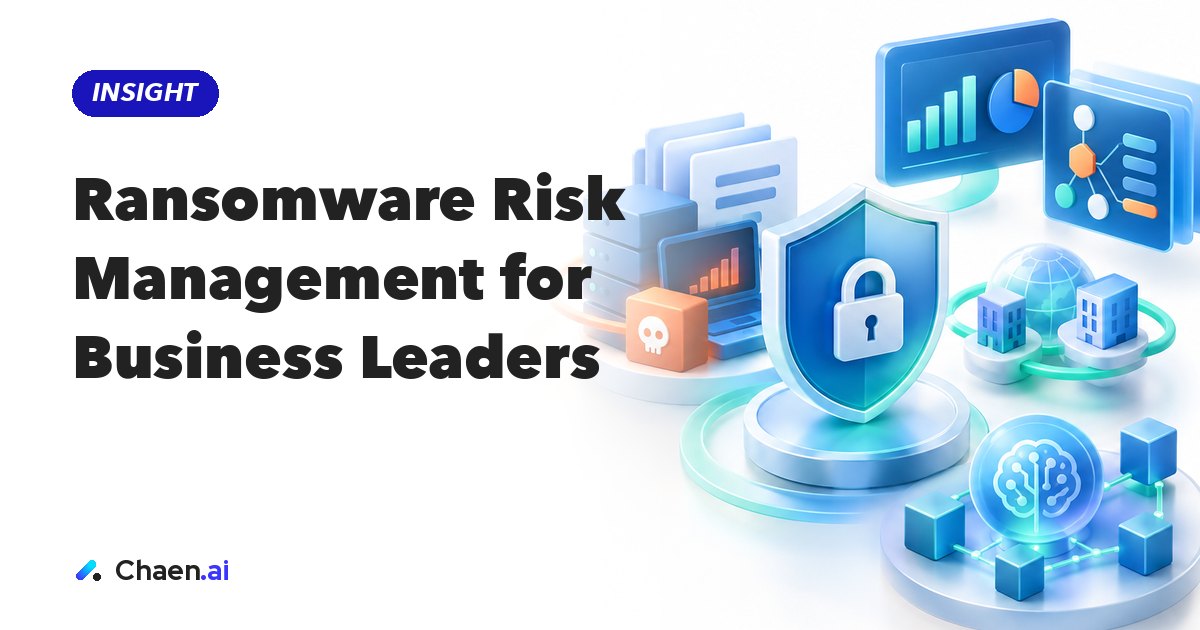
I examine ransomware risk management through Qilin’s comments and IPA’s threat rankings, with questions for leaders on suppliers and AI.
Ransomware risk management belongs on the management agenda, not solely with the technical team. I examine Qilin’s comments about Japan alongside IPA’s threat rankings to identify what business leaders should clarify about priorities, suppliers, and AI. The useful response is not to repeat an attacker’s assessment, but to turn the warning into decisions about your own organization.
Ransomware risk management starts with reading claims carefully
In my post, I discussed a response to JNN from Qilin, the ransomware group that attacked Asahi Group and other organizations. Qilin described Japan’s computer security in exceptionally negative terms and said attacks on Japanese companies and government bodies could increase.
That is a reason to pay attention, but it is important to separate the statement from its validity. An attacker’s description of Japan is not an independently established comparison of national security standards. The material in my post does not provide a common benchmark against which countries were assessed.
I therefore would not use the statement to declare where Japan ranks globally. Nor would I dismiss the need to examine our own preparations simply because the statement came from an attacker.
For a management discussion, I would replace the question “Is the attacker right about Japan?” with more useful questions:
- Can I explain what the company has chosen to protect first?
- Can the organization distinguish what it has checked from what it merely assumes?
- Is it clear who decides what to do about unresolved questions?
These questions do not establish whether a company is secure. They establish whether its leaders have a basis for discussing its security rather than reacting only to a headline.
Keep Qilin’s reported scale separate from future predictions
The information I shared described Qilin as a leading ransomware group, with more than 1,000 victim cases confirmed in 2025. Qilin also said it worked with more than 300 people worldwide.
Those details require careful handling. The figure of more than 1,000 should not be presented as a count of victims in Japan. The statement about more than 300 collaborators does not establish how many people are involved in attacks on Japanese organizations. It is also Qilin’s own description of its cooperation network.
The same discipline applies to the outlook. A statement that attacks could increase is not confirmation that they will increase. It does not identify a particular company as the next target.
In my post, I expressed concern about the number of information leaks and cyberattacks in Japan. However, the material does not establish a domestic growth rate or a breakdown of victims by industry. I would keep that concern separate from any statistical claim.
When sharing the issue internally, I would distinguish reported victim information, statements made by Qilin, and questions that remain unanswered about our own company. This preserves the seriousness of the warning without making the evidence say more than it does.
Use IPA’s threat rankings to define the review scope
My post also highlighted the leading entries in Japan’s IPA Information Security Top 10 Threats 2026:
- First: ransomware attacks
- Second: supply chain attacks
- Third: cyber risks involving AI
I would use these categories to broaden the management discussion beyond internal security measures. They provide a useful starting point for asking whether supplier relationships and AI use are included in the company’s review.
They do not, by themselves, determine a company’s investment priorities. Nor can their positions be translated into the probability that a particular company will suffer an incident. I would treat the list as a prompt to look for missing questions, not as a ready-made budget allocation.
For supplier relationships, I would first identify which external relationships the company intends to examine. I would then separate matters it can assess internally from matters that require a response from another organization. “A supplier handles that” should not be the end of the management discussion.
For AI, I would ask what information supports current decisions about its use. The post does not describe specific products or attack techniques, so it does not justify declaring a particular tool unsafe. The practical task is to clarify what the company knows and what it still needs to establish before making a decision.
Turn the warning into management decisions
If I were bringing this issue into an internal meeting, I would not stop at circulating a warning. I would organize the discussion around business priorities, the status of checks, and decision ownership. The following is the approach I would take, rather than a claim about measures already implemented by any company mentioned in the post.
Define protection priorities in business terms
“Improve security” is too broad to settle a difficult choice. I would ask which business activities and information the company most wants to protect, and what consequences leadership considers most important if those activities are affected.
The objective is not to label everything equally important. It is to establish a basis for choosing what receives attention first when several issues require a decision. Where leadership cannot yet set a priority, I would record why and what information is missing.
This gives the technical discussion a business direction without pretending that management can resolve technical questions simply by declaring an outcome.
Separate checked items from assumptions
I would review internal preparations, supplier-related matters, and AI use as distinct areas. For each, I would distinguish an established understanding from an assumption that something has probably been handled.
An unchecked item should not automatically be classified as either safe or dangerous. Instead, I would ask what needs to be learned before that judgment can be made. Making uncertainty visible is part of the report to management, not a failure to produce a report.
A useful summary would connect the business activity, the current state of understanding, the unresolved question, and the decision required. That is more actionable than a general assurance that security work is continuing.
Clarify who investigates and who decides
I would also distinguish responsibility for checking a situation from authority to set priorities. A person gathering information should not silently inherit every business trade-off attached to that information.
Where a decision is deferred, I would want the reason and decision owner to remain visible. Where more information is needed, I would identify who will obtain it. This keeps the conversation focused on specific choices rather than the vague question of whether the company is “doing enough.”
Review AI risk without assuming facts about an attack
My central concern in the post was that AI lowers costs for attackers, making security unmistakably a management issue. I believe leaders should consider the conditions facing attackers as well as the benefits they seek from their own AI use.
However, the material does not quantify that cost reduction. It also does not establish where AI was used in the attacks discussed. AI-related risk appearing high in a threat ranking is not evidence that AI was involved in a particular incident.
I would therefore avoid jumping from the word “AI” to a predetermined purchase or prohibition. Instead, I would revisit the assumptions behind current priorities. Does leadership still support them? Are there additional questions to check? If a proposed action is postponed, who can explain the reasoning?
The discussion need not become a choice between stopping all AI use and continuing without review. The information in the post cannot settle individual usage decisions. I would make those decisions by identifying what is known about the company’s own situation and what information is still needed.
For me, this is the practical connection between AI risk and management responsibility: leadership must own the basis for the decision, rather than leaving an unresolved business choice inside a technical discussion.
Apply the lesson to your own company
I would use this story to review the company’s protection priorities and the boundaries of its security checks. Alongside ransomware preparedness, I would make unresolved supplier and AI questions explicit and identify who must decide what happens next.
The aim is not to repeat an attacker’s judgment about Japan. It is to increase what the company can explain about its own position and make ransomware a concrete management agenda item.
FAQ
What did Qilin say about cybersecurity in Japan?
In its response to JNN, Qilin sharply criticized Japan’s computer security and said attacks on Japanese companies and government bodies could increase. Those are statements by an attacker, not the findings of an objective comparison of national security standards.
Which threats led IPA’s Information Security Top 10 Threats 2026?
The rankings I highlighted in my post placed ransomware attacks first and supply chain attacks second. Cyber risks involving AI ranked third.
Why should ransomware risk management involve business leaders?
I see it as a management issue as AI lowers costs for attackers. Deciding what to protect first, what to examine across supplier relationships, and who can accept unresolved risks requires business judgment as well as technical work.
Based on a post on XOriginal post ↗
About the author

CEO of DigiRise Inc. Has supported 600+ companies and 50,000+ people with AI training, consulting and development. GMO AI & Web3 advisor, Google Gemini AI advisor. 200K+ followers on X.
Related articles
 Influencer Marketing in Japan: A B2B and AI Playbook Oct 12, 2026
  Weekly AI news: Agents, Workflows and Security Oct 11, 2026
  Japan's Major AI Conferences and Trade Shows in 2026 Oct 11, 2026
  Japan's Top AI Influencers in 2026: Who to Follow and Work With Oct 11, 2026
  How to Market an AI Product in Japan: A PR Playbook Oct 11, 2026
  Gemini Agent Claude: What Businesses Should Assess Oct 9, 2026