Cyberattack Preparedness Through Japan’s Disaster Lens
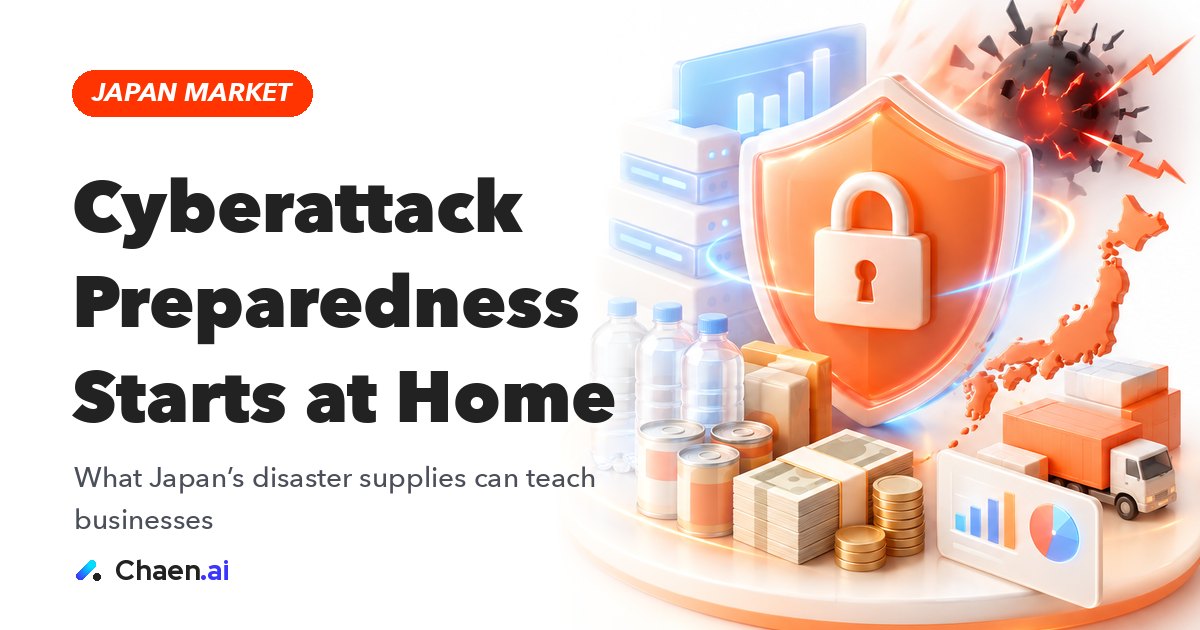
Cyberattack preparedness connects household supplies with disrupted logistics and payments. I examine the UK appeal and its relevance to Japan.
Cyberattack preparedness is not only a technical question: it can also mean keeping water, food, lighting and cash at home. The UK appeal I shared has much in common with Japan’s disaster-stockpiling guidance. I want to separate what was actually recommended from what businesses can learn about preparing for disruption and communicating that preparation in Japan.
The UK preparedness appeal was not an attack forecast
My post covered a call by the UK defence secretary for households to keep essential supplies. The accompanying notes referred to remarks on BBC Newsnight on October 22 and a further appeal after a speech in Telford that day. The concern was disruption to logistics and payments caused by cyberattacks and other events.
What stood out to me was a national defence leader connecting security concerns directly to ordinary household preparations. Water and canned food made the discussion concrete rather than leaving it at the level of threats and technical systems.
But an important qualification must stay attached to the message: the remarks stated that there was no information indicating an imminent attack. Concern about state-backed actors and terrorists should not be rewritten as a claim that an attack is about to happen.
The UK also acknowledged that its calls for preparation had lagged behind those elsewhere in Europe. I would not use that acknowledgement to rank countries. The more useful question is how a public warning becomes something people can act on without overstating what is known.
Reference links shared with my post: source one and source two.
Read the emergency supplies list by purpose
The household items in the appeal were straightforward:
- Three litres of water per person per day
- Several days of canned food that can be eaten without heating
- A battery-powered torch and a power bank
- Cash in case payment systems stop working
I find it more useful to connect each item with a situation than to treat the list as a shopping instruction.
Water and food address the question of what is already available at home if logistics are interrupted. The condition attached to the canned food matters: it should be edible without heating. Having food and being able to eat that food under the circumstances being considered are separate checks.
For the torch and power bank, I would check where they are and whether they are ready to use. That is my practical way of reviewing the listed items, not an additional specification from the UK appeal. Ownership alone is not the question I would use to assess readiness.
Cash addresses a different dependency: the ability to pay. It is useful to distinguish a payment problem from a supply problem. Cash does not, by itself, resolve interrupted deliveries, so I would review available goods and payment arrangements separately.
The material does not give a cash amount or a power-bank capacity. I would not fill those gaps with a universal recommendation. The supported starting point is the item and its intended purpose, not a level of precision the appeal did not provide.
Japan offers a familiar disaster-preparedness reference
The UK government’s Be Ready campaign recommends preparations to get through three days. In Japan, the Ministry of Agriculture, Forestry and Fisheries recommends at least three days to one week of supplies. Its water guideline is also three litres per person per day.
For readers outside Japan, that existing disaster-stockpiling guidance is the relevant local context. My observation was that the UK list closely resembles the supplies recommended for disaster preparation in Japan. It was not that every detail of the guidance is identical.
The duration is a clear distinction. The UK campaign’s three-day recommendation and Japan’s range of at least three days to one week should retain their separate labels. Combining them into a single international standard would go beyond the material.
For communication in Japan, I see an opportunity to start with existing supplies rather than presenting cyberattack preparedness as an entirely separate household task. The useful question is whether water, food and other preparations already in place would also support daily life during a logistics or payment interruption.
This framing has a boundary. Household supplies do not prevent a cyberattack. They are preparations for dealing with some of its possible consequences. I would keep attack prevention and preparation for disrupted daily life clearly separate.
Review household readiness before buying more
If I were reviewing a household’s preparations, I would begin with what is already there. A news report can prompt a check without automatically becoming a reason to buy a new set of supplies.
For water, I would distinguish the number of people from the number of days being planned for. The recommendation is expressed per person and per day, so simply confirming that there is water in the house does not answer the full question.
For food, I would review quantity and usability separately. Is there food for the intended period? Can the relevant items be eaten without heating? Those questions preserve the actual condition in the appeal rather than replacing it with a looser assumption that any stored food is equivalent.
For lighting and charging equipment, I would check location and condition. I would also want the people who may need the items to know where they are. These are proposed review steps, not claims about further instructions from the UK government.
Finally, I would consider payment disruption as its own scenario. Food supplies and cash serve different purposes; combining them into a single vague judgement that a household is “prepared” can hide what still needs checking. My aim would be to make each preparation understandable in terms of its use.
Communicating preparedness to the Japanese market
For businesses advancing AI or other technologies in Japan, this story offers a communication lesson rather than evidence about any particular product. I would begin with the service people depend on—deliveries or payments—before discussing the threat that could interrupt it.
An overseas company communicating in Japan can use the overlap with Japanese disaster guidance as a starting point. That gives the explanation a local reference without suggesting that the UK recommendations are themselves Japanese guidance.
I would review a company announcement or internal briefing against these questions:
- Does it retain the statement that there was no information indicating an imminent attack?
- Does it distinguish interrupted logistics from interrupted payments?
- Does it explain what each recommended item is intended to address?
- Does it keep household guidance separate from business-continuity requirements?
That final distinction matters. A recommendation for a household to get through three days is not a finding that a business can continue operating for the same period. The company’s dependencies still need to be examined on their own terms.
I would also avoid making the message more alarming merely to attract attention. The practical value of this example is its connection between a stated concern and a concrete preparation. For an audience in Japan, I would preserve that connection while accurately explaining the similarities and differences in the guidance.
Applying the lesson inside a company
Inside a company, I would use the story to start separate reviews of logistics dependencies and payment dependencies. For each, I would identify the work affected and the questions that need internal clarification.
If sharing household guidance with employees, I would keep it distinct from the company’s own continuity planning. The goal is not a more dramatic warning. It is a clearer understanding of what existing preparations can support, and which dependencies still need attention.
FAQ
What household supplies were recommended for cyberattack preparedness?
The appeal I shared listed three litres of water per person per day, several days of canned food that can be eaten without heating, a battery-powered torch and a power bank. It also included cash in case payment systems stop working.
How do the UK and Japanese stockpiling recommendations compare?
The UK government’s Be Ready campaign recommends preparations to get through three days. Japan’s Ministry of Agriculture, Forestry and Fisheries recommends at least three days to one week of supplies, with water measured at three litres per person per day.
Did the UK appeal indicate that an attack was imminent?
The remarks I shared stated that there was no information indicating an imminent attack. They nevertheless warned about state-backed actors and terrorists, and called for preparations for disruptions such as interrupted logistics or payments.
Based on a post on XOriginal post ↗
About the author

CEO of DigiRise Inc. Has supported 600+ companies and 50,000+ people with AI training, consulting and development. GMO AI & Crypto advisor, Google Gemini AI advisor. 200K+ followers on X.
Related articles
 Muji Data Breach: Card Numbers Used as Customer IDs Nov 14, 2026
 Nikkei selloff and KOSPI decline: reading the figures Nov 8, 2026
 AI adoption in Japan beyond social media hype Nov 2, 2026
 AI Tool Adoption in Japan: How Companies Decide Oct 26, 2026
 AI Localization for Japan: A Practical Guide Oct 23, 2026
 Japan Social Media and AI News: X, YouTube, LINE, note Oct 19, 2026