Inviting Japanese Creators to Global Tech Events
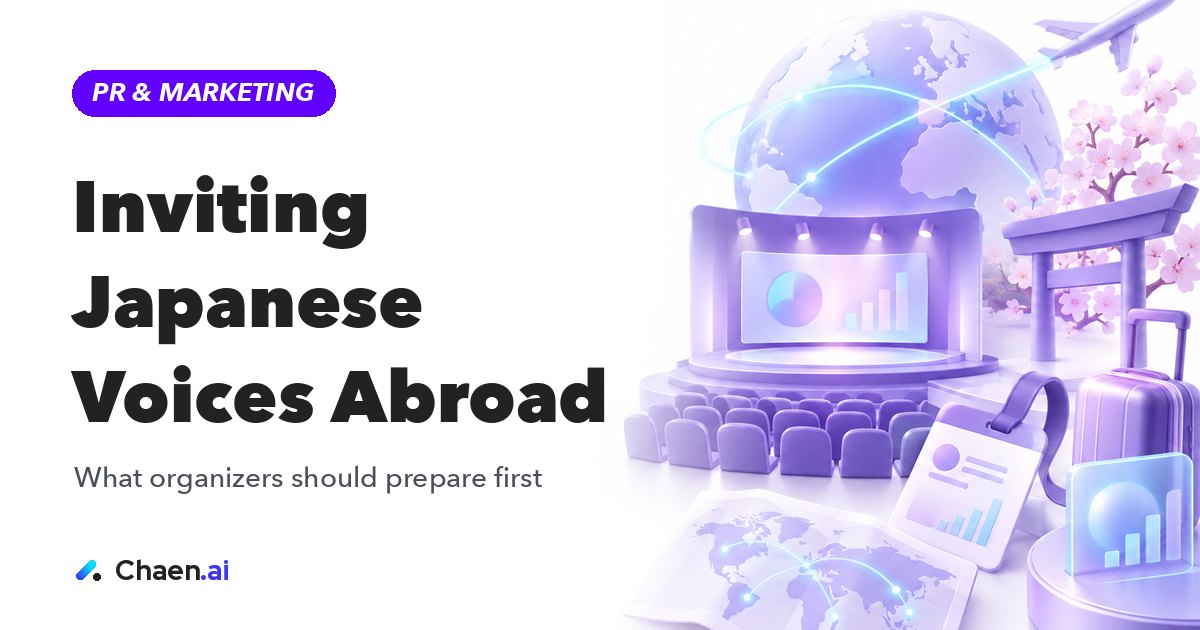
A practical guide to inviting Japanese creators to global events: what organizers should prepare, how to choose who to invite, and why Japanese audiences ask…
What actually happens when you invite a Japanese creator to your global event? I attended Google I/O (2025 and 2026) and Samsung Galaxy Unpacked 2026 in London on invitation, and covered BoxWorks Tokyo 2026 on a press pass. This article is written from the invitee’s side: where the value comes from, what organizers need to prepare, and how to choose who to invite. By the end you should be able to decide who to invite, when to reach out, and what to hand over.
Why invite a Japanese creator to a global event
The value breaks into three parts: speed to Japanese-language primary coverage, translation into Japanese business context, and the volume of explanation that continues after the event.
- Speed. When a Japanese-language creator is physically in the room, primary coverage in Japanese appears without waiting for official translation or for Western outlets to be re-reported locally. The first explanation Japanese readers encounter is closer to what you actually meant.
- Context. Japanese enterprises do not start from a feature list. They start from “where does this fit into our existing work?” and “how do I explain this to our IT department?” Someone who saw the product in person can rewrite the announcement around those questions.
- Continuity. Day-one coverage disappears within days. A creator who follows the same field continuously is still publishing how-to content weeks later. What remains is not exposure on the day but understanding that carries over.
The inverse is also true. If none of those three matter for a given announcement, you do not need a Japanese creator there. The effect shows up when the product is meant to be used in Japan, or when the announcement includes anything about Japanese-language support.
What a good invitation looks like from the invitee’s side
Once you are on the ground, the quality of the invitation design shows up directly in the quality of the coverage. Good invitations share the same traits:
- A written outline of what will be announced, and a clear publishable date and time, arrives before travel
- Photography and recording rules are explicit, as is how much can be written
- Hands-on time with real devices or demos is built into the schedule
- There is a slot, even a short one, to ask the people who built it a question
- Agreed translations exist for the terms that are awkward to render in Japanese
- The organizer says up front that favorable coverage is not expected
Weak invitations are the mirror image. The invitee learns everything only after arriving, leaving no time to think about what to publish. The publishable scope stays vague and the judgment is quietly pushed onto the creator. Nobody explains the venue flow, so the questions that mattered never get asked. The only assets provided are English-text images that are hard to use in a Japanese post. And the worst version is a program that feels engineered to produce flattering coverage. Readers in Japan detect that immediately, and the credibility loss lands on the host, not the creator.
The organizer’s checklist before the invitation goes out
Decide before you invite
- Pick one objective. Broad awareness, reaching enterprises evaluating adoption, or getting developers to try it are three different goals with three different invitee profiles.
- Write down the audience you want concretely. Industry and job function. Once that is specific, the choice of person almost resolves itself.
- Settle the disclosure rules first. If they stay ambiguous, the invitee defaults to caution and publishes something that says nothing.
Send before travel
- An outline with background, ideally showing the delta from previous announcements
- The publishable date and scope, written out in Japan time as well
- The day’s schedule and how to move around the venue
- Assets usable in Japanese posts. If images contain text, a Japanese version dramatically raises the chance they get used.
- Translations for key terms. Without them each creator invents their own wording, and the coverage becomes harder to find in Japanese search.
Prepare on site
- Hands-on time where the invitee touches the product themselves
- A short conversation with the people who built it. It does not need to be long; one sentence about intent changes the substance of an article.
- Interpretation for creators who are not comfortable with English Q&A. Communication reach and English fluency are separate skills.
- Clear statements of where and when filming is allowed
After the announcement
- Designate one channel for follow-up questions. Invitees arrive home with far more specific questions than they had on the day.
- Share back how the announcement landed in Japan. It feeds directly into the design of the next one.
- Do not treat it as a one-off. On a second visit the same person can talk about what changed since last time, which raises the density of the explanation.
How announcements land in Japan and why it changes your framing
Japanese enterprise reactions often diverge from how an announcement is received elsewhere. Across cumulative support for more than 600 companies and over 50,000 people on AI adoption, and more than 150 speaking engagements a year, the questions I get cluster in the same direction: which part of tomorrow’s work does this replace, will it clear our internal rules, and can it run alongside the tools we already have. Whether it lands in daily operations comes before performance numbers.
There is a direct implication for non-Japanese companies communicating in Japan. A Japanese translation of the announcement deck travels less far than an explanation of where the product fits, written in the language of Japanese work. Output quality in Japanese, handling of honorifics and internal terminology, and how pricing is structured all get asked about concretely here. A Japanese creator who watched the announcement in person sits exactly at that bridge. So design the invitation not around carrying “what we announced” back home, but around working out together “whose job in Japan this helps.”
One more piece of Japanese context worth knowing: adoption decisions here often involve more internal stakeholders than in other markets, and material that a champion inside the company can forward unchanged does more work than material aimed only at the end user. Coverage that explains use cases in operational terms becomes exactly that kind of forwardable material.
How to choose which Japanese voice to invite
What I would look at:
- Do they test things themselves? Output based on hands-on use, not summaries of other coverage.
- Do they stay in the field? Someone who has followed the same area over time can describe the delta. Someone who chases every trending topic cannot.
- Does their audience overlap with yours? Strength with consumers and reach into enterprise decision-makers are different assets. Choose against your objective.
- Are they independent? A creator who only ever writes positives is not trusted by readers, and that ends up as your loss, not theirs.
- How many formats do they work in? Writing, video, stage, books. More formats means the explanation keeps going longer after the event.
- Can they hold confidential information? A track record of honoring publication timing. Once that breaks it cannot be recovered.
The invitee has preparation to do as well. Before I travel I re-read the previous announcements and decide what I intend to bring back. It is impossible to follow everything in the venue, so narrowing the target before arriving produces deeper coverage, not shallower.
How to apply this inside your own company
An invitation to a global event is not a distribution tactic; it is a translation mechanism. If you are the one announcing, bring someone who can explain it in Japanese into the design phase, and settle disclosure rules, assets, and the question channel before you invite. If you are a Japanese company tracking overseas announcements, even without sending anyone on site, assign someone whose job is to restate each announcement as “which part of our work this affects.” Either way, the value of the information depends on whether you have someone whose role is to translate it into your own context.
FAQ
When should we reach out to a Japanese creator about a global event?
As soon as the announcement date and the publishable scope are settled. The invitee needs time for travel arrangements, background research, and planning what they will publish on the day. Sharing only a vague outline right before arrival cuts the value in half.
Should we just pick the person with the largest following?
Follower count alone is not enough. Look at whether they test products themselves, whether they have covered the same field continuously, and whether their audience overlaps with the buyers you want to reach. Reach tells you distribution, not depth.
How do we measure whether an invitation worked?
Do not judge by day-one post metrics alone. Look at whether explanatory content kept coming for weeks after, whether concrete adoption questions started arriving from Japanese companies, and whether the same person can move quickly for your next announcement.
Based on a post on XOriginal post ↗
About the author

CEO of DigiRise Inc. Has supported 600+ companies and 50,000+ people with AI training, consulting and development. GMO AI & Crypto advisor, Google Gemini AI advisor. 200K+ followers on X.
Related articles
 Press Release Distribution in Japan: Services and Media Oct 14, 2026
 Influencer Marketing in Japan: A B2B and AI Playbook Oct 12, 2026
 Japan's Top AI Influencers in 2026: Who to Follow and Work With Oct 11, 2026
 How to Market an AI Product in Japan: A PR Playbook Oct 11, 2026
 Muse Chrome Extension: What It Does vs Claude in Chrome Nov 22, 2026
 Muse Email Address: How It Works and Business Caveats | Meta Nov 22, 2026