PHP Vulnerability Found by AI: This Week in AI News
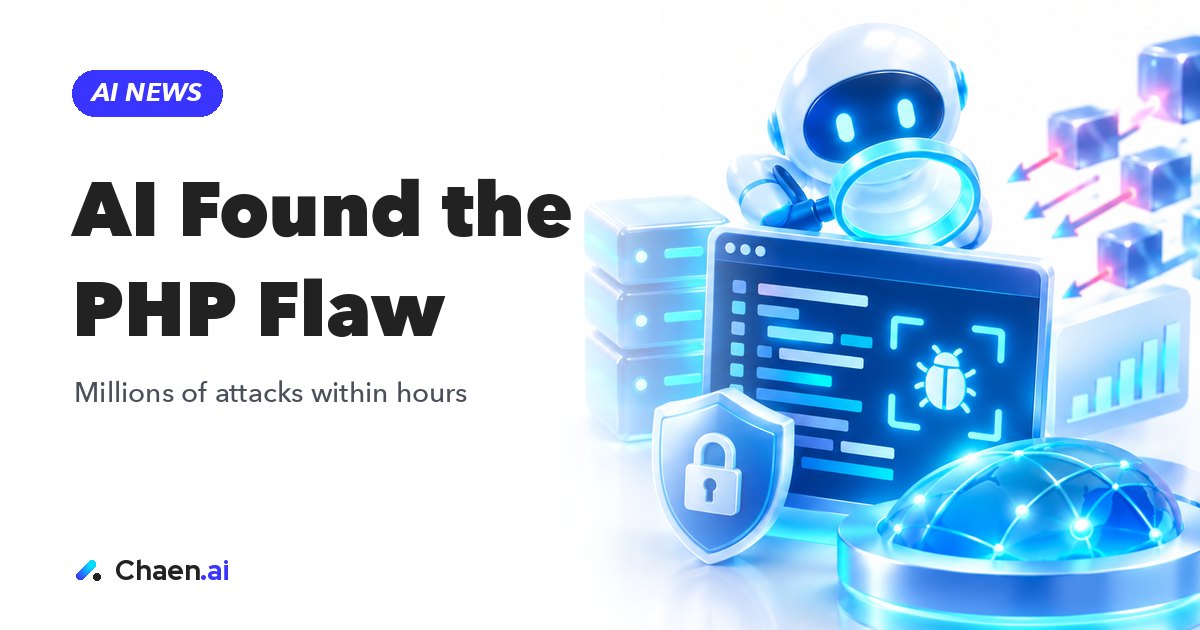
My weekly roundup: an AI found a critical PHP vulnerability before attackers, attack traffic hit millions after the patch, plus agent launches and what…
This is my weekly roundup of what I posted on X between October 20 and 24, 2026. One story dominated the week: an AI found a critical PHP vulnerability before attackers did, and once the patch went public, attack traffic climbed into the millions within hours. Below is what happened, what to check in your own stack, and how it looks from Japan.
The PHP vulnerability found by AI: what php2shell actually is
On October 21 it was disclosed that an OpenAI model had found a critical vulnerability in PHP. PHP is the behind-the-scenes language running roughly 70% of websites whose language can be identified — WordPress blogs, corporate sites, online shops. Magento, widely used for e-commerce, is also built on PHP.
Here is how the discovery went:
- The security company Calif found it using OpenAI’s GPT-5.6 Sol
- Wiz independently found and reported the same vulnerability through a separate route
- Two issues with a severity rating of 9.2. Fixed versions were published at 23:00 on October 21
- Fixing it was hard enough to require a major rebuild of PHP’s core engine. OpenAI spent two months working with PHP developers, security companies including Cloudflare, and US government agencies to prepare the fix and defenses before disclosure
- OpenAI described it as one of the most impactful vulnerabilities in recent years
The vulnerability is called “php2shell” and every web server running PHP 5.4 or later is in scope. A crafted request alone can stop a site, run arbitrary programs on the server, or pull customer data out. The heavy part is that takeover is possible from outside without logging in, which leads directly to member data leaks and site tampering.
The detail I think matters most: as far as OpenAI is aware, the AI found it before attackers did. People talk constantly about AI being used for attacks. This is a concrete case of the defending side getting there first and closing the hole before it was abused.
Millions of attacks after the patch: what to do right now
The genuinely dangerous moment with any vulnerability is right after the fix ships. Diffing the before and after lets attackers reverse-engineer where the hole is, so the race starts the instant the patch is public. With a major PHP vulnerability in 2024, attacks were observed within 24 hours of disclosure.
The same thing happened here. Cloudflare’s CEO published the numbers:
- 10 hours before disclosure: thousands of attacks
- 45 minutes after disclosure: tens of thousands
- 2 hours after disclosure: hundreds of thousands
- Now: millions
Worse, information had leaked ahead of the official disclosure date and attack traffic was already arriving. Attackers were varying their payloads slightly, probing for ways around defenses.
Cloudflare disclosed that it had deployed automatic protection for customer sites roughly nine hours before the public announcement. The new mechanism inspects not only incoming requests but the responses the server sends back in order to identify attacks. Anyone using the WAF, free plan included, was protected with no configuration.
But that only buys time. The vulnerability lives in PHP itself, so updating your site’s plugins does not fix it. PHP needs to be updated, and if a shared host or a production agency handles that for you, you should confirm where they stand. The point I want to stress hardest from this week: a patch existing does not automatically make your site safe. Check which versions and settings are affected, and if you are in scope, update urgently. In the thread on my post I also shared a prompt you can use with Claude Code or Codex to scan for this.
Node.js also shipped a high-severity fix
It was not only PHP. Node.js had a high-severity vulnerability with fixed versions published on October 21. Node.js is the engine running the back end of websites and AI apps — logins, data processing, a wide range of work. Depending on conditions, this issue can affect attacks against the server or the safety of communications.
The versions to move to:
- Node.js 22 line → 22.23.4
- Node.js 24 line → 24.22.1
- Node.js 26 line → 26.12.1
And how to read it per platform:
- Vercel: apps using Node.js can be in scope. Auto-update mechanisms exist, but you still need to check which version you are on
- AWS: if you manage Node.js yourself on EC2 or ECS, you need to update. Lambda varies by configuration
- Cloudflare: Workers runs on a separate runtime from standard Node.js, so this issue does not map over directly
Apps you built with Claude Code or Codex are no exception. Precisely because anyone can now build software with AI, security management has to cover the runtime environment and not just the code.
AI on the defending side: Anthropic’s free scanning and Altman’s remark
Two stories about AI as a defender landed in the same week.
First, Anthropic started offering free vulnerability scanning for open source software. Its top-tier models, including Claude Mythos, periodically hunt for vulnerabilities and report them. Over the past six months they surfaced 29,000 vulnerability candidates; of 97 critical ones that were verified, 85 (88%) cleared the reporting bar. Reports come with reproduction code and a proposed patch. Anthropic covers the entire cost — though it runs on an application and review basis, so that is worth noting.
Second, Sam Altman said that the strongest internal model they have cannot be open sourced for the time being. From a roughly 49-minute conversation at Stanford GSB, the key points were:
- OpenAI’s best internal model will not be released any time soon
- The condition for releasing it is rebuilding the internet’s cyber defenses
- A new layer of defense against bioweapons is also needed
- In his read, the gap versus open models at a comparable level is not large
Naming “rebuild the internet’s cyber defenses” as a release condition is a notably strong statement. Read the other way, it presumes that today’s defenses have not caught up. Put next to php2shell going from thousands to millions of attacks in a matter of hours, the weight of that remark is easier to feel.
AI agents moved into real work: Claude Duet, 1Password, Muse
Security dominated the week, but the agent side moved too.
Claude Duet. Anthropic’s new app is a proactive agent that acts before you ask. It feels close to having a capable secretary living on your phone, and I suspect it lands hardest for executives and sole proprietors. It sits in the same category as Grok bot, Dots, and Muse.
- Every morning it reports the items needing action, pulled together from connected apps
- Tasks you hand off keep progressing in the background while you step away
- It always asks for confirmation before sending, paying, or signing
- Runs on Opus 5.5 and supports over 6,000 connectors
1Password for Agents. You can hand an AI agent the login step without ever showing it the password. The agent requests the credential at login, you approve, and 1Password enters it directly — the agent never sees it. Over 14 companies are integrated, including Grok Bot, Muse, and Claude, and it is free on individual and family plans. This removes the single biggest worry about letting an agent make a booking or a purchase on your behalf, which makes it a big deal.
Muse finally launched in Japan. It is a personal AI agent that does not just answer questions but carries out the work: writing and sending email, operating a browser and filling in forms, searching and booking travel, running tasks across multiple apps, and remembering your preferences and past conversations. I will review how it differs from Grok dots once I have put real hours into it.
What is interesting is how these three connect back to the security story. Always stopping for a human before send, pay, or sign. Never exposing credentials to the agent. The competitive axis for agents is shifting from raw capability toward how tightly permissions are scoped.
Voice AI and robots
ElevenLabs announced Eleven Realtime, a model that responds directly from speech to speech. I tried it immediately and the result is on another level — clearly ahead of GPT-Live 1.1, Gemini Live, and Grok in my testing. Its Japanese is at a point where I cannot distinguish it from a person. Around 0.5 seconds to start speaking, 98.8% on Big Bench Audio (v1 Max, per the company’s announcement), two models in v1 Mini and v1 Max, and an OpenAI-compatible Realtime API. Voice AI for call centers is going to sound substantially more natural because of this.
Unitree revealed H2-X Kung Fu Legend Guardian, a humanoid robot aimed at security work. Up to roughly 8 hours of continuous operation, a demo standing on 4m-high scaffolding, and night-time security demos in a scrapyard and at a residence — an aggressive way to present it. Humans are advised to stay at least 2 to 3 meters away from the robot. How far this actually goes in security patrols and night rounds is worth watching.
What this means in Japan: the biggest risk is the news not arriving
In Japan the PHP issue escalated to the point where the Prime Minister commented on it. Even so, what scares me most is that the large majority of companies almost certainly do not know about it. The number of executives and system administrators who follow X and the news in real time and act on it is quite limited.
A lot of Japanese corporate sites run on a combination of WordPress, a shared hosting provider, and an outside production agency — which means the decision to bump the PHP version does not sit in-house at all. So the first move here is not “update PHP ourselves” but “identify who is responsible for updating it.”
There is a lesson here for overseas AI and security companies that want to reach Japan. An English engineering blog does not reach the people doing the work. The speed at which information arrives in Japanese becomes the speed of your defense. And it helps to clearly separate two things: what users are already protected from without doing anything, and what they still have to act on themselves. Cloudflare’s announcement landed because it stated both the covered range and the remaining homework.
Looking a bit further out, the part that concerns me is finance. If AI-driven hacking keeps advancing at this pace, I have a feeling we get an economic crisis on the scale of Lehman. Three reasons:
- Major banks will eventually be breached too. In 2025, unauthorized trades from hijacked domestic securities accounts alone came to roughly 740 billion yen. Now that AI has automated attacks, banks being targeted is a matter of time
- If one bank falls, you get a run on all of them. Once word spreads that deposits were stolen, depositors at other banks rush to withdraw. Japan has about 117 trillion yen in physical notes against over 1,000 trillion yen in deposits. The cash for everyone simply does not exist
- Modern bank runs finish in hours. Silicon Valley Bank in 2023 was financially sound, yet about 6 trillion yen was withdrawn in a single day via smartphones and it failed
A bank that cannot pay, then suspicion spreading to other banks, then money no longer circulating. That is the same sequence as Lehman. The money in your account has value because everyone believes the numbers. AI may be able to break that trust itself. I expect more people to start holding physical cash at home or in a safe. This was also the week I finally felt the meaning of Einstein’s line about what the third and fourth world wars would be fought with.
How to apply this week at your own company
If I were turning this week into action, I would start here.
- Confirm your site’s PHP version and the person responsible for updating it, today. If no one owns it, that is your biggest hole
- Check your Node.js versions against 22.23.4 / 24.22.1 / 26.12.1, including internal apps you built with AI
- Designate one internal point of contact for receiving vulnerability information. This week, whether the news arrived at all was the whole difference
- Update your criteria for adopting agents: can a human stop it before send, pay, or sign, and is it built so the agent never sees credentials
AI speed applies equally to attack and to defense. The gap does not come from model quality — it comes from how long it takes you to act once the information reaches you. This week put a number on that.
FAQ
What makes the php2shell PHP vulnerability dangerous?
It affects every web server running PHP 5.4 or later. A crafted request can take a site down, run programs on the server, or extract customer data. Two issues rated 9.2 in severity were patched on October 21.
Does applying the patch automatically make my site safe?
No. The flaw is in PHP itself, so updating your site's plugins does not fix it. You need to update PHP, and if a shared host or a web agency manages it for you, confirm their status directly.
Which Node.js versions contain the fix?
22.23.4 for the 22 line, 24.22.1 for the 24 line, and 26.12.1 for the 26 line. If you manage Node.js yourself on EC2 or ECS you need to update; Lambda depends on your configuration, and Cloudflare Workers is a separate runtime.
Based on a post on XOriginal post ↗
About the author

CEO of DigiRise Inc. Has supported 600+ companies and 50,000+ people with AI training, consulting and development. GMO AI & Crypto advisor, Google Gemini AI advisor. 200K+ followers on X.
Related articles
 Muse Chrome Extension: What It Does vs Claude in Chrome Nov 22, 2026
 Muse Email Address: How It Works and Business Caveats | Meta Nov 22, 2026
 GPT-Live-1.1 API: What Changed for Voice Agents Nov 21, 2026
 Gemini 4 Neon: How to Read Performance and Price Nov 21, 2026
 Grok 5 vs Opus 5.5: How to Read Musk's 2-3 Month Claim Nov 15, 2026
 AI News Roundup: Claude Meetings and NVIDIA's CEO Exit Nov 15, 2026