Google Satellite AI: Suncatcher's First Orbital Run
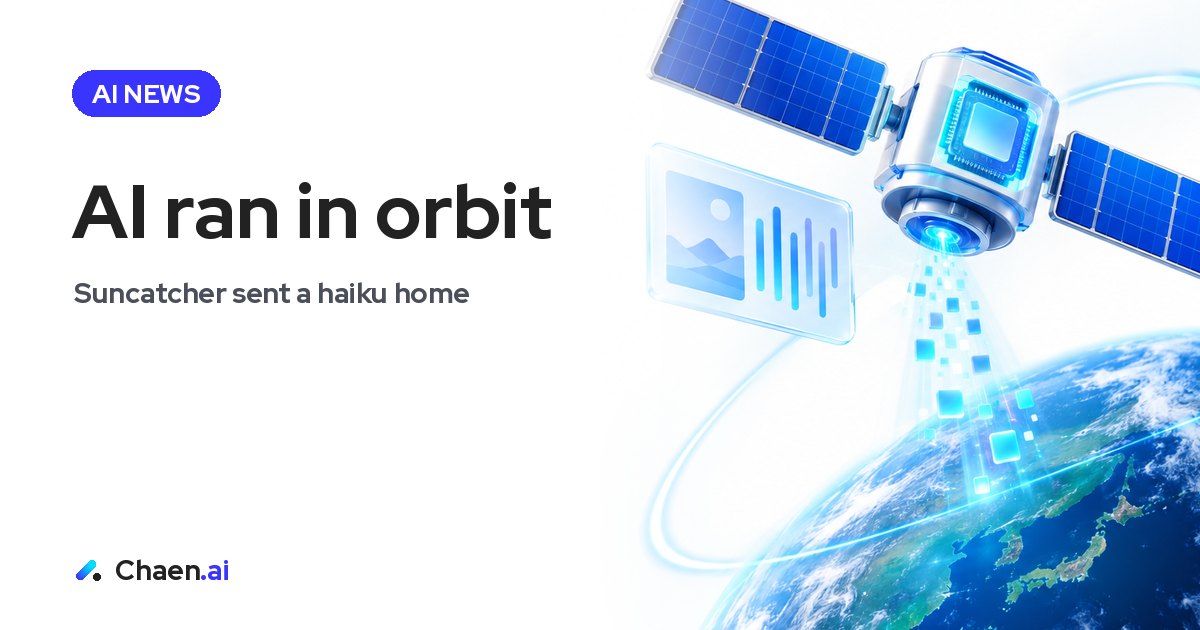
Google satellite AI ran Gemma on an orbiting TPU and beamed a haiku back to Earth. What Project Suncatcher proved, what is unsolved, and why it matters.
Google has run an AI model on a satellite in orbit and sent the answer back down to Earth. The output was a haiku. A single short poem sounds modest, but as far as I can tell this is the first time power generation, compute and downlink were strung together end to end on real hardware in space. This piece covers what Google’s satellite AI demonstrated, which problems are still open, and how I think teams in Japan should read it.
Google’s satellite AI produced an answer in orbit
In one line: a prompt went up from the ground and an AI in orbit sent an answer back. Written out, it sounds unremarkable. But for that round trip to happen, three things had to hold at the same moment — electrical power, a computer booting and running a model, and a working link to the ground. Everything a terrestrial data center takes for granted becomes a separate thing to verify once you leave the atmosphere. That is why the size of the output does not matter much here. A haiku is enough.
The timing is the other half of the story. The prototype satellite for Project Suncatcher, the plan Google announced in 2025, launched only a few weeks ago. Going from launch to on-orbit inference that quickly is what made me stop and read twice. My own post about it drew roughly 38,000 views, which tells me the space-plus-AI combination lands well with Japanese-language readers too.
The likely flow
- A ground station sends a prompt up to the satellite
- The TPU carried on board is powered up in orbit
- Gemma runs inference on solar power
- The generated haiku is sent back down to Earth
Those four lines are my reconstruction from public information and they include inference on my part. The details may change as more is published, so hold them as a probable shape with unconfirmed specifics. What is not in doubt is that the full loop — instruction up, compute in orbit, result down — closed.
Where Project Suncatcher stands today
Suncatcher is a Google moonshot announced in November 2025. At the time of the announcement, the stated plan was to work with the satellite company Planet and launch two prototype satellites by early 2027. Measured against that timeline, the program is still near its starting line, and it has already cleared the on-orbit inference milestone. The distance between announcing an ambitious architecture and running one real end-to-end test on real hardware turned out to be short.
There is also a cost projection attached. Launch costs are expected to fall below 200 dollars per kilogram by the mid-2030s, and if that holds, the operating cost of a space data center could be comparable to the cost of electricity on the ground. That sentence is the part I would not skip. Suncatcher is not framed as going to space because space is exciting. It is framed as an economic question: where is the cheapest place to manufacture compute? Read it that way and the engineering choices below stop looking exotic.
Why run AI in space instead of on the ground
The answer is power. AI compute needs enormous amounts of electricity, and on the ground, generation, transmission and siting all become hard constraints. In orbit the constraints change shape.
- Google estimates solar panels in space can generate up to eight times what they generate on the ground
- An orbit that rides the boundary between day and night generates almost continuously
- With near-continuous generation, you barely need to carry heavy batteries
That last point is easy to underrate. Dropping most of the battery mass feeds straight back into launch cost, so the economics improve twice over: better generation per panel, and less mass to lift per unit of compute. The underlying move is worth naming clearly. Instead of absorbing an energy shortage through clever data center engineering, this approach changes where the energy is generated in the first place.
The three walls: radiation, bandwidth and formation flying
The open problems have been published too, which I appreciate. Three stand out to me.
- Radiation: Google’s own AI chip, the TPU (Trillium), was exposed to a proton beam in testing and held up better than expected
- Bandwidth: the design links satellites to each other with laser light, and ground experiments reached 1.6 Tbps
- Formation: the concept packs 81 satellites inside a one-kilometer radius so the cluster can be used as a single data center
Each of the three has moved forward on its own. The hard part is holding all three simultaneously. A chip that survives radiation is not useful if the link is too thin to behave like a data center. A fat link does not help if formation control drifts and the inter-satellite lasers cannot hold a lock. Seen that way, the haiku is best understood as the first time all of it was connected on real flight hardware at once — one thin thread through every layer, rather than a finished system.
How this reads from Japan
I will be direct: this does not change anyone’s work next month. It belongs in the same category as autonomous driving and quantum computing — a long game. Even so, from where I sit helping Japanese companies adopt AI, there are two useful readings.
The first is about cost. In Japan, discussions about AI spend tend to compare model costs against headcount or against the existing systems being replaced. This announcement is a reminder that the price of AI is ultimately pulled along by where electricity gets produced. Having a company the size of Google state that premise publicly is genuinely useful inside a Japanese organization, where mid-term plans need to be defensible to people who are not in the room for the technical discussion. You do not need to predict the timeline. You need an axis for what happens to unit compute cost over the next several years to exist in the plan at all.
The second is about how to run a pilot. Suncatcher describes an 81-satellite architecture and then flew one haiku, end to end. That pattern — publish the ambitious picture, prove the thinnest possible complete path first — transfers directly to internal AI adoption. Japanese enterprises often do the opposite: scope the full rollout, debate it for two quarters, and never close a single loop. A big vision and a deliberately small first proof are not in conflict.
There is a third note for overseas AI and tech companies trying to reach the Japanese market. The output being a haiku is part of why this traveled so well in Japanese. I should be careful here: nothing public explains why a haiku was chosen, so that is my observation and not a stated intent. But the general lesson holds. Even a deeply technical announcement lands differently when there is one point of contact with the audience’s own context. That is cheaper to arrange than most companies assume, and it is usually decided at the demo stage rather than in the press release.
What to take into your own company
- Put energy into your internal cost models as a variable, not as background noise
- For long-horizon technologies, decide to watch rather than to adopt, and write down in advance what event would trigger a re-review
- Before scaling any AI pilot, push one thin case all the way from input to delivered output
Space feels far away, but the handling is ordinary technology assessment. You do not have to be right about when it arrives. It is enough to have already put into words what would change if it did.
FAQ
What did Google actually run on the satellite?
A TPU carried on the satellite was powered up in orbit and Gemma performed inference on solar power. The haiku it generated was sent back down to Earth.
What is Project Suncatcher?
It is a Google moonshot announced in November 2025. At announcement the plan was to work with the satellite company Planet and launch two prototype satellites by early 2027, and that prototype launched only a few weeks ago.
Why put AI compute in space at all?
AI compute needs enormous amounts of power. Google estimates solar panels in space can generate up to eight times what they do on the ground, and an orbit riding the day-night boundary generates almost continuously, so heavy batteries are largely unnecessary.
Based on a post on XOriginal post ↗
About the author

CEO of DigiRise Inc. Has supported 600+ companies and 50,000+ people with AI training, consulting and development. GMO AI & Crypto advisor, Google Gemini AI advisor. 200K+ followers on X.
Related articles
 Muse Chrome Extension: What It Does vs Claude in Chrome Nov 22, 2026
 Muse Email Address: How It Works and Business Caveats | Meta Nov 22, 2026
 GPT-Live-1.1 API: What Changed for Voice Agents Nov 21, 2026
 Gemini 4 Neon: How to Read Performance and Price Nov 21, 2026
 Grok 5 vs Opus 5.5: How to Read Musk's 2-3 Month Claim Nov 15, 2026
 AI News Roundup: Claude Meetings and NVIDIA's CEO Exit Nov 15, 2026