GPT-6 Astra Hardware Prototype: A Codex Device in One Week
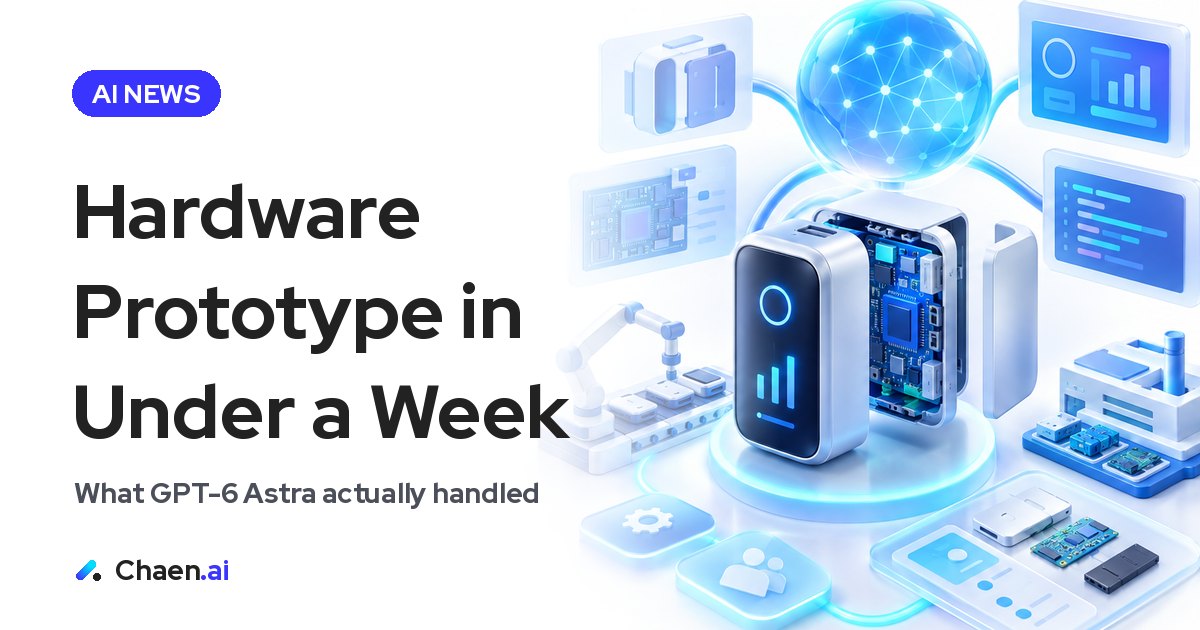
Two OpenAI engineers built a Codex device prototype with GPT-6 Astra in under a week. What Astra handled, what the factory needed, and why it matters.
Two OpenAI engineers teamed up with GPT-6 Astra and prototyped a dedicated device for talking to Codex in under a week. This piece sorts out only what was actually disclosed about that GPT-6 Astra hardware prototype, where a human still had to step in, and how to turn the pattern into a judgment rule for your own hardware work. The thing worth noting is not the finish quality. It is that an enclosure, a board, a UI and the software were all cycled through once inside side-project time.
What GPT-6 Astra actually handled in the hardware prototype
The disclosed facts are short, and keeping them short is the point.
- Duration: under one week, run as a side project
- People: two OpenAI engineers
- Astra’s scope: enclosure, circuit board, UI, software
- Output: a dedicated device you talk to Codex through
Pricing and availability are not in the thread. I am leaving that blank rather than guessing, because a guess there turns this into a different story. One note for readers outside Japan: a missing price line is the first thing a Japanese enterprise team will be asked about internally, and an honest blank is far easier to defend than a filled-in assumption.
The racing and automotive cases are still at the weakness-finding stage
Two further uses were named alongside it. Chip Ganassi Racing turned 3D scans into drawings. Mazda simulated the design of a new car model. Neither was presented as a finished design pipeline. The engineers are checking the outputs and surfacing the model’s weak spots, and that is explicitly the stage both are at. So the present value sits less in the deliverables and more in the map of where the model gets things wrong.
Why “under a week” matters: the loop, not the finish
Hardware development eats time less through individual tasks than through round trips between layers. Change the enclosure and the board layout moves. Change the board and the software’s assumptions move. Change the software and the UI copy moves. Because one person cannot hold that whole loop, the work gets split across specialists, and splitting it introduces waiting.
What seems to be doing the work in this case is that the vertical loop ran end to end in one place. If a full pass fits into side-project hours, “build it, look at it, throw it away” becomes a real option. A concept you would have argued about in slide decks for three weeks can instead be judged against something that moves.
If you want to use that in practice, the order matters more than the tooling.
- Decide up front what unit you are willing to throw away. The goal of a pass is a decision input, not a finished product.
- Separate reversible layers from irreversible ones. Drawings, UI and software can be redone. Tooling, component orders and safety-related calls cannot.
- Put the human review immediately before the irreversible step. That is the one place to slow down on purpose.
- Write one line per pass on what you learned. The faster you loop, the more learning evaporates without a record.
The part AI did not finish is where the method hides
The explicit caveat in the follow-up is that reaching manufacturing still required several rounds with a factory, so this was not completed end to end by AI. That is too useful to read as a footnote. The round trips that remain point directly at the steps where humans still carry the value.
The factory holds what shape is producible, at what cost, on what lead time. Of course an AI-generated form does not flow straight into production. The real question is which pass you learn those constraints on. If one loop is now cheap, you can move the factory conversation earlier instead of later: show a deliberately disposable prototype, absorb the constraints first, and let the next loop already respect them. That reordering is the most portable thing in this story.
What I see using Codex and Claude Code in robot development
We use Codex and Claude Code in our own robot development, and they are genuinely strong. Implementation speed goes up, but the bigger change is the number of attempts. Once attempts are cheap, decision quality stops depending on prompt craft and starts depending on whether you can state clearly what you are trying to confirm.
So the internal bottleneck moves off the code and onto verification. Who checks whether an output is correct, and how? Are we expanding into areas we have no way to check? That the racing and automotive cases are described as weakness-finding exercises fits the same shape. When generation speed and verification capacity are out of balance, the speed does not convert into results.
How this lands in Japan, and what overseas AI companies should say here
The common failure when sharing a story like this inside a Japanese company is a translation slip. Only the headline travels — “a prototype in a week” — and inside the organisation it mutates into “so can AI do all of our design work?” Handing over the boundary along with the headline changes the next several months. Two sentences are enough: Astra handled enclosure, board, UI and software, and manufacturing still required rounds with a factory. With those paired, the internal discussion stays grounded.
Japan has a large base of companies that actually make physical things, so this case lands better as “raise the number of prototype cycles” than as “AI replaces the work.” When the design loop gets faster, the parts that were previously hidden — factory back-and-forth, internal approval waiting time — become the visible bottleneck. Expecting improvement work to shift there is the practical way to prepare.
The implication for overseas AI companies communicating in Japan sits in the same place. Your Japanese counterpart is the person who has to build the internal explanation deck, and a demo with fuzzy boundaries cannot be carried home. Show what the model did and where people stepped in as separate lines, and if pricing and timing are not public, say so. That reads as trustworthy here rather than evasive. In this case OpenAI is stated to be looking for engineers, design firms and software partners to experiment with. For Japanese design houses and software firms, that is a readable entry point: get involved as a verification partner now rather than waiting for a finished product.
Applying this inside your own company
The easiest move is to carve out one loop you could run and discard in a week. Keep the scope small. Pick a theme that crosses whichever layer — enclosure, board, UI, software — your team currently stalls between. Put a human review just before the irreversible step. Record what each pass taught you. Then show it as early as possible to whoever holds the physical constraints. Whether you spend the new speed on finish quality or on the number of decisions you get to make is the difference this case is worth taking away.
FAQ
What does the GPT-6 Astra prototype device do?
It was built as a dedicated device for talking to Codex. Astra handled the enclosure, the board, the UI and the software. No further specifications were given in the original thread.
Did AI really do the whole thing in under a week?
No. Getting to manufacturing still took several rounds of back-and-forth with a factory, so it was not fully completed by AI. The accurate reading is that one design loop became very fast.
Is pricing or availability public?
Neither pricing nor availability appears in the thread. OpenAI is at the stage of looking for engineers, design firms and software partners to experiment alongside.
Based on a post on XOriginal post ↗
About the author

CEO of DigiRise Inc. Has supported 600+ companies and 50,000+ people with AI training, consulting and development. GMO AI & Crypto advisor, Google Gemini AI advisor. 200K+ followers on X.
Related articles
 Muse Chrome Extension: What It Does vs Claude in Chrome Nov 22, 2026
 Muse Email Address: How It Works and Business Caveats | Meta Nov 22, 2026
 GPT-Live-1.1 API: What Changed for Voice Agents Nov 21, 2026
 Gemini 4 Neon: How to Read Performance and Price Nov 21, 2026
 Grok 5 vs Opus 5.5: How to Read Musk's 2-3 Month Claim Nov 15, 2026
 AI News Roundup: Claude Meetings and NVIDIA's CEO Exit Nov 15, 2026