Zuckerberg on Musk's Twitter Restructuring: A Japan View
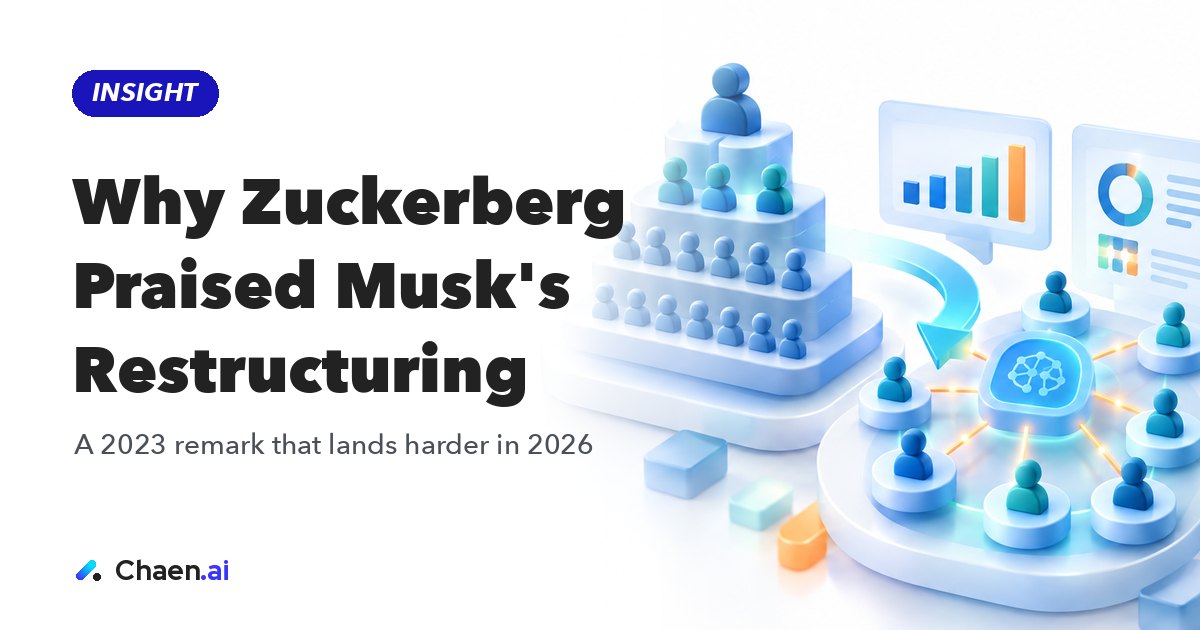
Zuckerberg called Musk's Twitter restructuring mostly right - praising fewer management layers, not the headcount cut. What it means for Japan in 2026.
In October 2026, a clip from a 2023 Lex Fridman Podcast episode started circulating again: Mark Zuckerberg saying that Elon Musk’s restructuring of Twitter was “mostly right.” It is unusual for one founder to publicly back a rival’s most contested decision. But the more useful part is the split inside the statement - what he endorsed, and what he deliberately refused to endorse. This piece breaks down the four points he made, the line he drew around them, and why a three-year-old remark reads differently in 2026, especially for companies in Japan.
I’m Masahiro Chaen (Chaen), CEO of Digirise in Tokyo. I shared this clip with my Japanese audience and it traveled further than I expected, which is itself part of the story.
What Zuckerberg actually praised in Musk’s Twitter restructuring
Four points:
- Make the organization more engineer-centric
- Shorten the distance between engineers and the top
- Reduce layers of management
- Other companies privately wanted to do the same thing but couldn’t bring themselves to
The fourth is the one I keep returning to, because it isn’t a claim about Twitter at all. It’s a claim about every other large company: the diagnosis was widely shared, and what differed was the willingness to act on it. That moves the subject from “was the restructuring good” to “why does a change everyone agrees with stay undone.” The second question is portable. Most executives I talk with can name a change in their own company that fits it within seconds.
The line he drew around his own praise
He also stopped short, on purpose. Whether the cuts went too far, he said, isn’t something you can judge from outside, and he wasn’t in a position to argue it either way.
For scale: Musk has said he took Twitter from roughly 8,000 people to roughly 1,500 after the acquisition - his own account, given to the BBC in April 2023. Zuckerberg did not bless that number. He blessed a direction: fewer layers, engineers closer to the center, a shorter path to whoever decides.
That distinction is the first thing lost when a clip gets re-shared under a short headline. “Zuckerberg says Musk was right about cutting staff” and “Zuckerberg says flattening the org was right” are different sentences with different consequences. If you quote this, quote the limit too. The restraint is part of what he said, not a footnote to it.
Why it matters that Meta was doing the same thing
The “March letter” referenced in the video is Meta’s own March 2023 organizational change, which set out reducing layers of management. So Zuckerberg wasn’t commenting from the stands. He was mid-execution on the same direction when he said it.
That changes how to read the quote. A bystander saying “he was right” is offering an opinion. A participant saying “he was right” is also, partly, explaining his own decision. Neither is disqualifying - but reading it as an operator’s self-explanation accounts for the texture of the language. He talks about layers and distance, which are mechanics, rather than boldness or vision, which are adjectives. People defending a decision they are currently executing tend to describe mechanics.
This is a generally useful filter for executive commentary. Before weighing what a leader says about another company’s move, check whether they are making the same move themselves. The sentence doesn’t change; what it is evidence of does.
Why a 2023 clip resurfaced in 2026
My read: the assumption about headcount moved.
AI now absorbs part of the research, part of the implementation, part of the document production. The same unit of work increasingly moves with fewer people involved. And when that happens, the questions a team starts asking look a lot like the 2023 questions:
- How many layers does a decision actually need to pass through?
- How much of the organization exists to coordinate other parts of the organization?
- How far is the person building from the person deciding?
In 2023 those questions were asked in the language of cost. In 2026 they’re being asked in the language of throughput. The framing changed; the mechanics didn’t. That’s why an old remark sounds current.
One caution worth stating plainly: AI raises output per person. It does not reduce the number of approvals by itself. Throughput and decision latency are separate systems, and adopting a tool only speeds up one of them.
How this lands in Japan
In Japan this thread was read as a management question, not as overseas HR news - which is why it spread. That’s worth unpacking for readers outside the country.
Many Japanese organizations route decisions through a sequence of written approvals, by design rather than by accident. The upside is that decisions are documented and broadly owned. The cost is distance: by the time a proposal reaches whoever can say yes, several people have handled it, and none of them built the thing. So the specific item Zuckerberg praised - compressing the gap between the engineer and the top - maps onto a real and widely felt problem here, far more directly than the headcount story does.
Copying the number doesn’t copy the shape
What was endorsed was layers and distance. If you reduce people while keeping the same number of approval steps, the load on the remaining people goes up and the intended effect never arrives. The order matters: change how decisions get made, then reconsider the shape of the team around that.
For global AI companies communicating in Japan
If you’re a non-Japanese company using stories like this in the Japanese market, framing decides the reception. Told as a layoff success story, it mostly produces discomfort and a defensive read. Told as “we shortened the path from the person building to the person deciding,” it connects to something Japanese operators already want.
Zuckerberg’s own restraint is a usable template here. He endorsed a direction and explicitly declined to judge the magnitude from outside. Specific about mechanics, non-committal about another company’s internals - that combination travels well in Japan, where confident outside pronouncements about how a company should be run tend to get discounted.
Questions to ask before you remove a layer
What I actually check:
- Who makes the final call on this project?
- How many approvals does a proposal pass before work can start?
- Does the person building have a direct path to the person deciding?
- Is a manager’s week mostly coordination and reporting?
- Where AI made a step faster, did the queue behind it get longer?
The last one is the most common pattern I see right now. If the work takes half a day and the approval takes a week, the organization’s shape is setting the pace, not the tooling. That’s a structural finding, and no additional tool purchase fixes it.
Taking it back to your own company
The takeaway isn’t “cut people.” It’s: count the steps between the person building and the person deciding, and ask whether that count matches the speed the work now moves at. Companies that have already put AI into a few workflows are exactly the ones who should check whether the time they saved is sitting in a queue.
Then turn the fourth point on yourself. If there is one change you already believe is right and still haven’t made, what is it, and what is actually stopping it? That question - not the headcount figure - is what makes a 2023 clip worth watching in 2026.
FAQ
Did Zuckerberg fully endorse Musk's cuts at Twitter?
No. He said the direction was mostly right, but added that whether the cuts went too far cannot be judged from outside and that he was not in a position to argue it. What he endorsed was the shape of the organization - fewer layers, shorter distance to decision-makers - not the size of the reduction.
When did Zuckerberg say this?
On the Lex Fridman Podcast in 2023. The clip circulated again in October 2026.
What is the "March letter" mentioned in the clip?
It refers to Meta's own organizational change announced in March 2023, which included reducing layers of management. So Zuckerberg was speaking as someone executing the same direction himself, not as an outside observer.
Based on a post on XOriginal post ↗
About the author

CEO of DigiRise Inc. Has supported 600+ companies and 50,000+ people with AI training, consulting and development. GMO AI & Crypto advisor, Google Gemini AI advisor. 200K+ followers on X.
Related articles
 PHP Vulnerability Response in Japan: Closing the Gap Oct 21, 2026
 Ransomware Risk Management for Business Leaders Oct 7, 2026
 How to Book an AI Speaker in Japan: Criteria and Process Oct 21, 2026
 Japan Social Media and AI News: X, YouTube, LINE, note Oct 19, 2026
 Claude Code Session Management with Emoji Status Prefixes Oct 18, 2026
 Weekly AI News Roundup: Gemini 4 Argon and DeepSeek V4.1 Oct 18, 2026