WeChat Palm Payment in Shenzhen: What I Learned Trying It
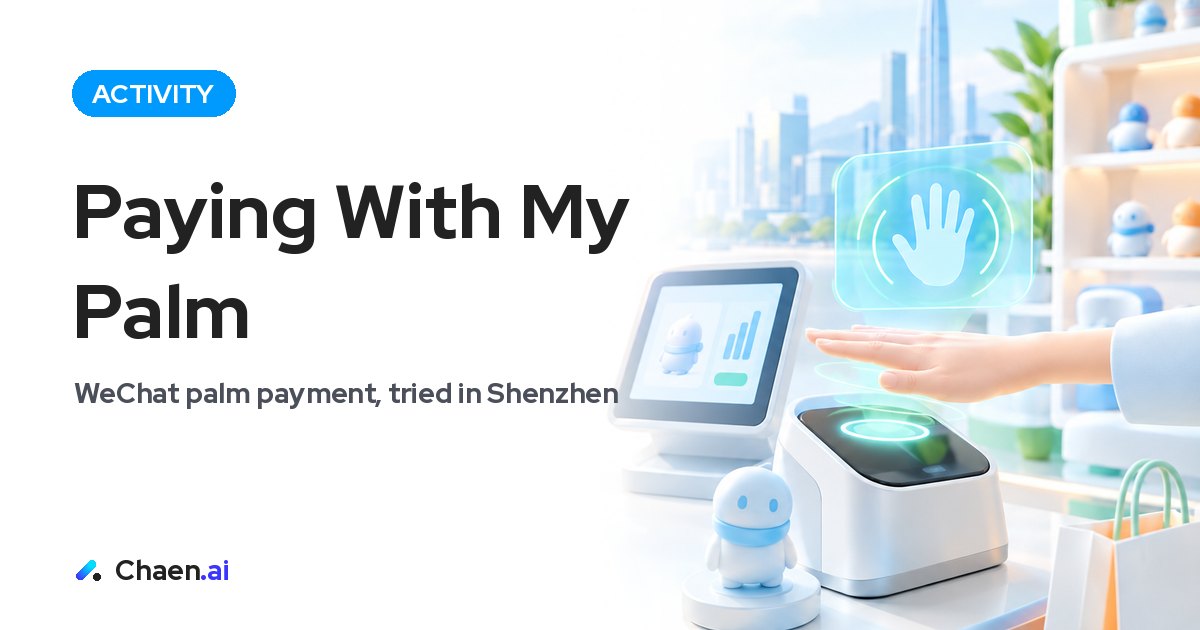
I tried WeChat palm payment at Tencent in Shenzhen and bought a QQ penguin mascot with my hand alone. How enrollment works, what the sensors read, and what it…
I tried WeChat palm payment at Tencent in Shenzhen
I visited Tencent in Shenzhen, China, and tried 微信刷掌 — WeChat palm payment, where your hand alone completes the transaction. At the register I took out no phone and no wallet. I held up my palm and the payment was done. This article covers exactly what I did, what I was told about how the reading works, and what people who are pushing AI and digital projects inside Japanese companies can take from it.
Here is the conclusion first. What struck me was not the sophistication of the sensing. It was how light the experience felt because there was nothing to take out at all. When I evaluate a new technology, the number worth looking at is not in the spec sheet — it is how many of the user’s physical actions disappeared.
What actually happened at the register
What I bought was a QQ penguin mascot. The price was 35.5 yuan. The procedure was to turn my palm toward the terminal at the register and hold it there. That was all of it.
Break an ordinary payment into steps and you get a chain: take the phone out of a pocket or bag, wake the screen, open the app, display the code, let the terminal read it. With palm payment that entire chain collapsed into one motion — putting my hand out. I understood this in advance intellectually. Experiencing it is different. The moment the checkout ended while my hand was still in the air, the shape of “paying for something” shifted slightly in my head.
Counting the steps that disappeared
The part that carries the experience is not accuracy. It is the removed steps. We do not notice the motions we perform every day. Only once they are gone do we register that they were work.
When I look at a new service, I do not ask whether it seems convenient. I count how many user actions it eliminated. Palm payment eliminates an obviously large number, which is why it is hard to go back to the previous method after one use. The inverse is just as useful as a filter: a feature that removes a single step will not change anyone’s daily life, no matter how novel the underlying technology is.
Enrollment took about a minute, with a color camera and an infrared one
Here is what I was told on site, alongside what I confirmed by doing it myself.
- What is read: the pattern of the palm, and the veins under the skin
- The reading uses two cameras — one color, one infrared
- Enrollment means holding your hand over the terminal and linking it to WeChat on your phone
- Enrollment took me roughly one minute
The phone is not needed at the moment of payment, but it is needed at the entrance: the palm gets tied to your existing WeChat account. So the payment itself completes at the hand, while identity and history stay on an account the person was already using. The new biometric was added onto an account people already have, rather than shipped as a separate service that has to acquire users from zero. To me, that structural choice matters as much as the sensor.
What I asked about security
The first thing anyone wants to know is whether a photograph of a hand or a fabricated hand would pass. The explanation I received was that a hand with no blood flowing through it does not authenticate. Reading with both a color camera and an infrared one connects to the same point.
I want to be precise about the limits of what I can claim. I heard an explanation, and I passed authentication once with my own hand. I did not test how hard the system is to defeat, so I will not write anything about that. What I can say is that an answer was prepared for the question a user asks first — and preparing that answer is itself a design decision made by someone who expects mass adoption.
“It is becoming common in Shenzhen”
I was told locally that this way of paying is becoming common in Shenzhen. I saw one counter, on one visit, so I am not going to assert anything about the whole city. Still, the fact that an outside visitor could enroll on the spot without a tutorial and walk out with a purchase says something real about how finished the implementation is.
How Japanese companies should read this
If you are weighing new payment or authentication methods in Japan, the thing worth copying is not the novelty of the palm. It is the order in which the problem was solved.
Where you place that one minute of enrollment
Enrollment took about a minute. Short, but not zero. However good the in-use experience is, nobody gets to it unless they cross that minute. So the real design question is where enrollment happens: in the checkout queue, at the door on the way in, or inside an app the person already has open. Whether a new authentication method spreads is decided by the placement of the enrollment path, not by the performance of the authentication.
Anything that takes custody of the body needs an explanation up front
A card or a phone can be cancelled when lost. A palm cannot be reissued. So users want to know, before any technical detail, whether they can decline, what gets stored, and how to stop using it. If you are evaluating this kind of system in Japan, publishing — in user language, not spec language — what is read, what it is linked to, and how it can be undone is a precondition rather than a nice-to-have. What reassured me in Shenzhen was not the depth of the specification. It was that my question got an answer on the spot.
Frame it as a shorter checkout, not as removing staff
Biometric payment gets discussed as a way to cut headcount. That is not what I experienced. I did not experience service disappearing; I experienced checkout getting shorter. Inside a Japanese company, that framing will also travel further in a proposal. What you are cutting is motions, not people.
If you are a non-Japanese company explaining this in Japan
For overseas AI and tech companies bringing this kind of technology to a Japanese audience, listing specifications is not what lands.
- Say in the first sentence what the user no longer has to take out
- Answer the fears about spoofing and data retention before anyone asks
- Give people somewhere to touch it, because reading about it does not transfer the feeling
The only reason I can write this article is that I actually held up my hand and bought one thing. I have not yet paid with my palm alone anywhere in Japan, which is exactly why a single hands-on minute changed my understanding. If you want to reach Japanese readers and the people who make decisions inside Japanese companies, building a place where they can try it beats adding more words. Obvious, and I confirmed it with my own hand.
Putting this to work in your own company
The way to bring this home is not to ask whether you can deploy palm payment. Start by counting, in your own service, what your users are taking out and which screens they are opening. Then look for the motions you could remove with the same mindset. Once you decide a motion can go, design the rest of it too: where the one minute of setup lives, and how you answer the anxiety before it is raised. That order is what I took away from Shenzhen.
FAQ
What does WeChat palm payment actually read?
I was told it reads the pattern of the palm and the veins beneath the skin, using two cameras: a color camera and an infrared one. The explanation I received was that a hand with no blood flowing through it will not authenticate.
How long does enrollment take?
You hold your hand over the terminal and link it to WeChat on your phone. In my case the whole thing took about a minute.
Do you still need your phone to pay?
At the moment of payment I took out neither a phone nor a wallet — holding up my hand was the entire action. The phone is involved earlier, at enrollment, when the palm is linked to your WeChat account.
Based on a post on XOriginal post ↗
About the author

CEO of DigiRise Inc. Has supported 600+ companies and 50,000+ people with AI training, consulting and development. GMO AI & Crypto advisor, Google Gemini AI advisor. 200K+ followers on X.
Related articles
 Claude Meetings: Features, Pricing, and My Hands-On Test Nov 22, 2026
 Claude Code Conversational Control: What I Learned Nov 10, 2026
 Grok Bot MCP Integration: Running Claude Code from Chat Nov 10, 2026
 AI Replies: Why I Plan to Build a Reply System Nov 8, 2026
 Weekly AI Report: Robotics and Real-World Adoption Nov 8, 2026
 Claude Code Parallel Agents: 20 Sessions From a Conference Nov 7, 2026