Weekly AI Report: Robotics and Real-World Adoption
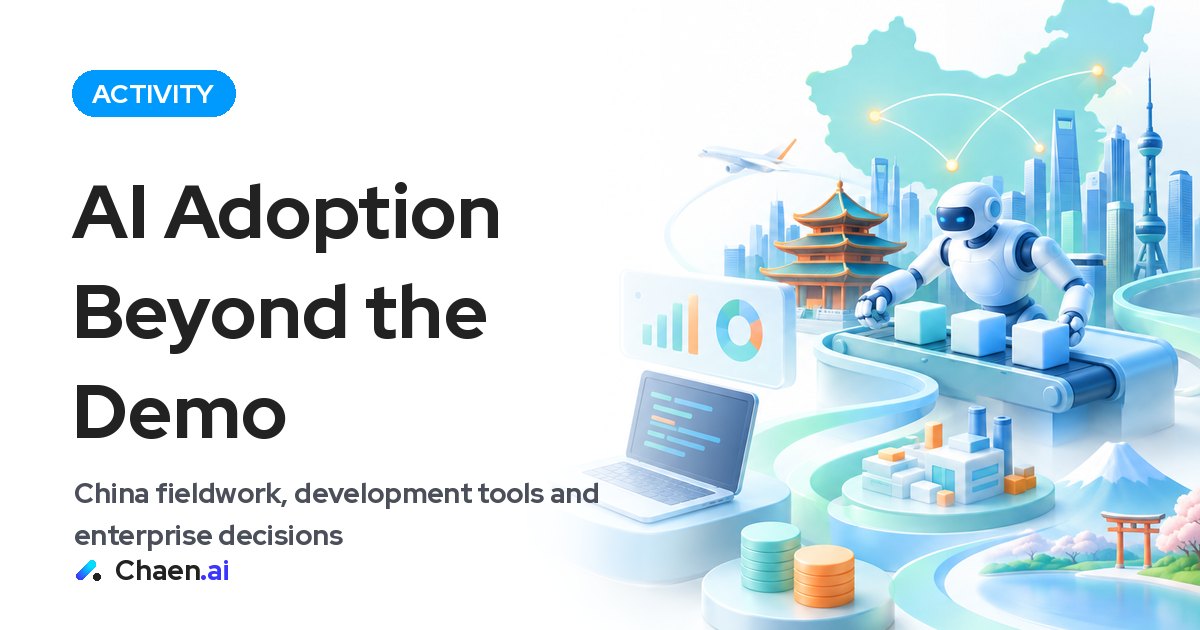
My Weekly AI Report covers robotics in China, AI development tools and the cost, access and trust questions behind adoption in Japan.
This Weekly AI Report brings together my robotics experiences in China, my development work and the announcements I shared during the week. I separate firsthand observations from product claims and forecasts, then consider what they mean for companies adopting AI in Japan and overseas teams entering the Japanese market.
Physical AI in China: what I observed firsthand
The biggest benefit of my China trip was experiencing the industry’s energy directly. Investment in factories, the pace of development, government support and the presence of strong companies across different locations stood out. I also encountered caution. My impression was not simply enthusiasm: there was real demand, and conversations with developers revealed things that social media did not.
I visited DEEP Robotics. Its humanoid moved quite naturally and had an imposing presence, although I see quadruped robots as the company’s stronger area.
At the Hangzhou Marathon, its humanoid traffic-police robots were operating early in the morning. They wore fluorescent-yellow traffic-police bodies, and one scene showed two walking together across a pedestrian crossing before dawn, close to runners and cyclists. This illustrated the speed of deployment into actual streets. It did not, by itself, establish their traffic-management capabilities or safety.
I also tried an AI massage robot. It felt comfortable enough that I initially wondered whether a person was doing the massage. That experience made me think it could appeal to users in Japan. This was a personal reaction, not a verified market-demand estimate.
Partnership discussions progressed during the trip. I am considering establishing a Chinese company again after seven years and would like to visit monthly. Connectivity was the practical downside: even with a VPN, I struggled to use Claude Code, and my productivity suffered.
In my return-trip post, I outlined plans to speak in Makuhari at 9:30 the following morning and then travel to San Francisco. Comparing physical AI in China and the United States was the next objective, not a comparison already completed in this report.
Claude Code: moving from a 3D scene to testing data
I asked Claude Code to create a factory simulation. More importantly, I could export underlying data for robot testing:
- Simplified USD for Isaac Sim, including collision geometry and labels
- A navigation map for ROS 2 nav2
- 32 target locations in front of shelves
- Simulated overnight driving logs for two robots
These were simulated logs, not records of physical robots operating overnight. For a company trying something similar, I would begin with the question to be tested, identify the required map and target data, and check whether the outputs serve that purpose. A convincing 3D scene is not the same as a validated deployment.
At Digirise, I also use Codex and Claude Code in robot development. Separately, I shared a story about two OpenAI engineers working with GPT-6 Astra to prototype a dedicated device for speaking to Codex in a side project lasting less than a week. The tasks attributed to Astra were the enclosure, circuit board, UI and software. The post also mentioned Chip Ganassi Racing turning 3D scans into drawings and Mazda simulating a new vehicle’s design.
Those examples were separate from my own factory project. What interests me across them is the movement beyond code generation into physical design, interfaces and testing materials.
I also posted a less serious development anecdote: wearing shorts in an over-air-conditioned conference, I ran Claude Code in 20 parallel instances for tasks including video editing and joked about using the heat as heating. That was a joke, not an operational recommendation. Wearing long trousers would have been the better starting point.
AI interfaces: learning, silent input and video editing
During the China trip, I used ChatGPT to learn Chinese. With one prompt, I created an interactive learning interface rather than just requesting translations.
It displayed natural Chinese, pinyin and Japanese translations together. Vocabulary explanations covered meaning, tones and pronunciation, with expandable details. I could filter categories such as AI terminology, see grammar and word order through colors and diagrams, compare three expressions ranging from casual to business, copy the Chinese and finish with a multiple-choice quiz.
The useful connection was between translating, understanding and checking recall. I would start with expressions needed in actual work and build the learning material around them. An English version was something I offered to create if there was interest, not a completed release.
For input, I shared Subvocal’s glasses and its $1.3 million funding from YC and Afore Capital. The described approach sends radar signals toward the face to detect tiny movements of speech muscles without contact, turning silent mouth movements into text. The company claimed more than 200 words per minute and silent conversation between wearers. I did not independently measure those capabilities.
I see potential in places where speaking aloud is inconvenient, such as cafés and trains. If usable for directing AI agents, it could also become an alternative input method; that was my interpretation, not a tested integration.
For video, I covered Archon from Selendis, co-founded by Steve Aoki. The announcement described turning raw footage into a finished video within minutes, learning preferences from previous or reference videos and becoming more personalized through editing. It also offered three free months for waitlist registration. I have attended Aoki’s performances several times, but Archon remained something I wanted to try, not something I had reviewed firsthand.
Enterprise AI: access, running costs and model strategy
I shared Claude’s MCP automatic connection beta for Team and Enterprise. The described EMA setup lets administrators connect an organization through an identity provider. If the IdP is unsupported, Claude handles identity verification. The announcement described continued use without reauthentication after connection and support for 14 providers, including Notion, Figma, Atlassian and HubSpot.
My interest was the reduction in asking every employee to authenticate individually. For Japanese enterprise buyers, I would make the administrator’s tasks and the employee’s tasks explicit. Overseas vendors explaining their products in Japan should show that workflow, rather than stopping at a list of integrations.
Running costs were another theme. Responding to complaints about tighter Grok Bot limits, Elon Musk said serving costs had been too high relative to revenue to be sustainable. This does not prove that every free AI allowance will shrink. It does suggest that workflows should not depend entirely on current terms remaining unchanged.
Claude Code’s background subagents provided a more specific cost example. I shared an update replacing full-conversation rereading for status updates every 30 seconds with short notes used by Haiku 5.5. The reported reduction was about 99% per status update and about 5% in allowance consumption across a session, for v2.1.316 and above. The distinction matters: 99% was not a reduction across the entire workload.
For model strategy, I added English and Japanese subtitles to footage I recorded of NVIDIA’s Jensen Huang. I agreed with the approach of using leading closed models while eventually building company-specific intelligence with open models: delegate what can be delegated, and retain intelligence specialized in the company’s domain.
My prediction is that within two years, open models will approach today’s frontier level, become smaller and support companies building their own models. That is my forecast, not a confirmed timetable. I would separate the capabilities available now from the knowledge a company wants to retain over time.
Cybersecurity and markets: keep the claims separate
I also shared reporting about a cyberattack and unauthorized transactions at a major French bank, including a reported loss of approximately ¥21 billion. The bank said customer assets were unaffected. I did not argue that this incident alone eliminated trust in banks.
I am concerned that AI could make attacks more sophisticated, but I did not establish that AI was used in this incident. My point was preparedness without panic, including considering whether funds should be spread across multiple banks.
In another post, I covered a 6% one-day Nikkei decline and roughly ¥70 trillion in lost market value. I also reported an 8.5% KOSPI decline, approximately KRW 250 trillion lost and a 20-minute trading halt. The declines from June highs cited in that post were 22% for the Nikkei and 48% for the KOSPI.
These market movements were not presented as caused by AI. Technological progress, cybersecurity exposure and market volatility should not be collapsed into one causal story.
Applying this week’s lessons inside a company
I would separate firsthand results, announced capabilities and forecasts, then choose a narrowly defined test. Japanese companies should clarify the intended use of outputs, access requirements and running costs. Overseas teams targeting Japan should explain who configures what and what a buyer can actually verify. The practical lesson is to move from discussing AI’s potential to specifying the conditions under which it can be used.
FAQ
Can Claude Code create a factory simulation?
I used Claude Code to create a 3D factory simulation and export data for robot testing. The outputs included simplified USD for Isaac Sim, a ROS 2 nav2 map, 32 target locations and simulated overnight logs for two robots.
How did I use ChatGPT to learn Chinese?
During my China trip, I used a single prompt to create an interactive learning interface with Chinese, pinyin and Japanese translations. It also provided vocabulary explanations, visual grammar guidance, alternative expressions and multiple-choice quizzes.
Who is the Claude MCP automatic connection beta for?
The announcement I shared covered Team and Enterprise. It described organization-wide connections managed through an identity provider, with 14 supported providers including Notion and Figma.
Based on a post on XOriginal post ↗
About the author

CEO of DigiRise Inc. Has supported 600+ companies and 50,000+ people with AI training, consulting and development. GMO AI & Crypto advisor, Google Gemini AI advisor. 200K+ followers on X.
Related articles
 Claude Meetings: Features, Pricing, and My Hands-On Test Nov 22, 2026
 Claude Code Conversational Control: What I Learned Nov 10, 2026
 Grok Bot MCP Integration: Running Claude Code from Chat Nov 10, 2026
 AI Replies: Why I Plan to Build a Reply System Nov 8, 2026
 Claude Code Parallel Agents: 20 Sessions From a Conference Nov 7, 2026
 ChatGPT Language Learning: Notes From a China Trip Nov 5, 2026