DEEP Robotics Humanoid Traffic Police Robot in Hangzhou
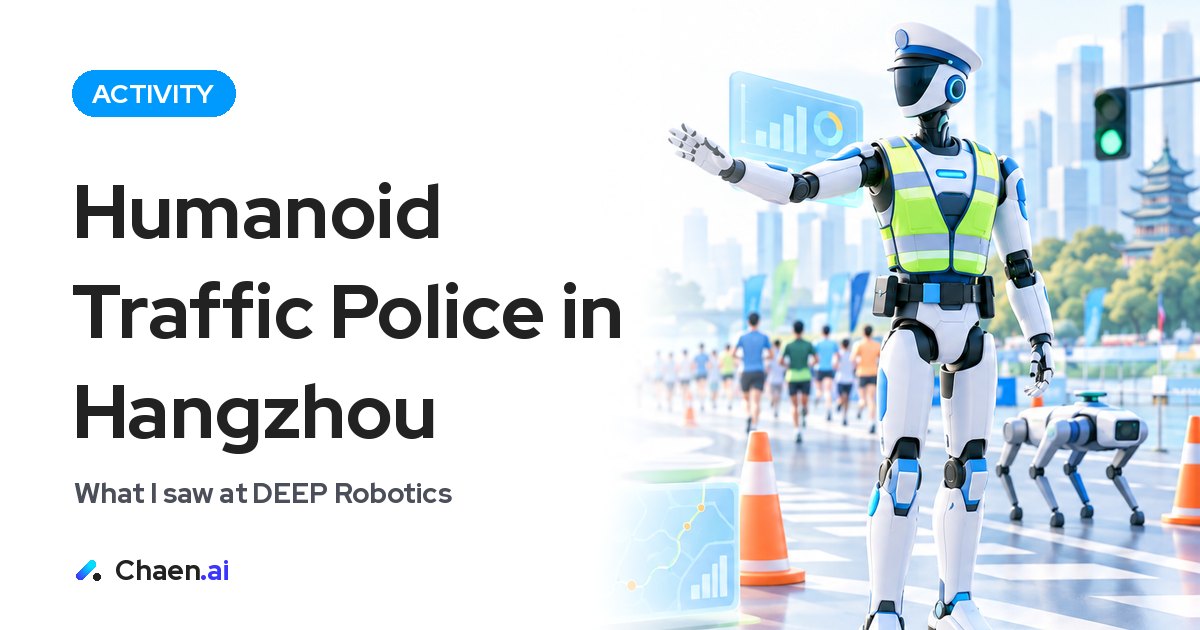
A DEEP Robotics humanoid traffic police robot worked the Hangzhou Marathon before dawn. What I saw on site, how it compares to their quadrupeds, and what it…
At the Hangzhou Marathon in China, a humanoid robot from DEEP Robotics was working the site as traffic police. Fluorescent yellow traffic police livery, on duty from early morning before the runners set off, and at one point two of them walking a crosswalk side by side. In this piece I want to cover what I saw, what I noticed when I visited the company, and what companies in Japan — plus overseas robotics firms that want to reach the Japanese market — can actually take from it.
Let me give the conclusion first. What struck me was not the performance of the humanoid itself. It was the speed of the decision to put a humanoid into a live event on public roads.
DEEP Robotics’ humanoid traffic police robot at the Hangzhou Marathon
The event itself is simple to state. At the Hangzhou Marathon, a humanoid robot dressed in traffic police specification was standing on duty. That is all that happened. But once you line up the conditions, it starts to read differently.
Here is the full set of facts I can confirm:
- The location was Hangzhou, China, at the Hangzhou Marathon
- It was operating from early morning, before runners started
- It wore a fluorescent yellow traffic police body
- There was a scene with two of them walking a crosswalk side by side
The reason I paid attention is that this was not a trade show booth. Humanoid robots have become a standard sight at expos over the last few years. They walk inside a cordon, run a fixed routine, and get applause. That part is no longer rare. What is different here is that the cordon is gone, there are spectators, and there are moving humans. The sequence has advanced one step.
What was actually happening on the crosswalk
The image that stayed with me is the pre-dawn crosswalk: a humanoid robot walking right alongside runners and cyclists, as if that were normal. No special enclosure, not positioned for viewing, just standing there as part of the morning’s operations.
The conditions are harder than a lab
Break the setting down and you can see it is not an easy one. It is dark. The road surface is not necessarily flat. The surroundings include runners before the start and cyclists, both of whom move unpredictably. The position is a crosswalk, where flows of people cross each other. That is the gap between a demo and a deployment. In a demo you get to fix the conditions; in a live road event the conditions change on you.
Why two robots matter
The detail I would not skip is that two of them walked the crosswalk together. One unit can be explained away as “we tried putting it out there.” Running two units in the same place at the same time requires operating procedure. Who is watching them. How do you stop them if something goes wrong. What hours are they standing. You cannot get to two units without answering those questions. So the natural read is that this was designed as an operation, not improvised as a one-off.
What I noticed when I visited DEEP Robotics
I have visited DEEP Robotics. My impression of the humanoid there came down to two things: the motion was fairly natural, and it had an imposing presence.
Looking natural is a functional requirement
If you evaluate a humanoid robot only on spec numbers, you will misjudge it. What matters once you place it in shared human space is whether the people around it can relax. If the gait looks wrong, people keep their distance. And once people keep their distance, a job like traffic control — a job that consists of getting humans to move — stops working. Looking natural is not cosmetics; it is part of the function. On that count, from what I saw, it cleared the bar.
Imposing presence is not automatically a negative
On the presence, I would avoid scoring it in one direction. For a traffic or security role, a robot nobody notices is useless. People slow down, look over, and follow the instruction simply because it is standing there. That effect suits a traffic police role rather well.
In a different setting, though, the same presence turns straight into a weakness. Guiding visitors in a commercial facility, staffing a reception desk, anything close to healthcare or elder care — you do not want a presence that makes people brace. Moving the same platform to a different use case will require tuning exactly here. The same characteristic becomes a strength or a flaw depending on the job. For anyone evaluating humanoids, that is the practical fork in the road.
Quadrupeds are still where their strength is
DEEP Robotics is a Hangzhou robotics company whose main line is industrial quadruped robots. Its 2025 revenue was roughly 337 million RMB (about 7.4 billion yen), around 3.3 times the previous year. The business that is growing sits in the quadruped line, not the humanoid one.
My own read matches that. Their strength is in quadrupeds. Humanoids get the attention, but once you factor in stability on uneven ground and the practicality of keeping a machine standing for long shifts, the quadruped has the edge. Reading this deployment as “humanoids have reached practical use” would be getting ahead of the evidence.
So why send the humanoid onto the road
Why put out the humanoid, which is not the company’s strongest card, at a public road event? My interpretation is that a traffic police role is work done in the same space as people, facing people.
- It can be expressed as a uniform. A fluorescent yellow traffic police livery only really works on a humanoid form
- People direct their attention toward human shapes. Attracting attention is itself part of the job
- Standing, walking and signalling map directly onto the existing image of the role
The choice was not made on technical difficulty. It was made on fit with the role. Seen that way, “the strength is in quadrupeds” and “the humanoid goes on the road” do not contradict each other.
Why China gets robots onto real streets faster
The strongest impression I took away is that China moves at a different speed when it comes to putting robots onto actual streets. I would not file that away as purely a technology story.
The speed is not mostly about technology
What I think the speed actually consists of comes down to three things.
- The place of use is decided first. Rather than waiting for a general-purpose machine, it is assigned to the bounded role of event operations
- It goes live before it is finished. The judgment is whether it works on site, not whether the demo is polished
- One shift serves several purposes at once. Communications, validation and field data all advance together
A humanoid robot generates almost no information while it sits in a lab. The moment you place it where people walk, reactions you did not anticipate start appearing. Whoever collects those first gets ahead on the next revision. That, to me, is the real nature of the speed.
How this lands in Japan
When the same footage is watched in Japan, I find the first reaction is not “amazing” but something closer to “is that safe?” What if it falls. Who is liable if it hits someone. Is it acceptable to station it at a dark crosswalk before dawn. There is nothing wrong with framing the question that way — if anything, those are unavoidable points for getting to real deployment in Japan. The problem is when the evaluation stops before anyone answers them.
It is worth noting for readers outside Japan that this caution is not simple technophobia. Japanese organisations tend to want the failure path specified before the success path, and a vendor who arrives with only the success path tends to stall.
What Japanese companies and overseas robotics firms can take from this
Let me close by splitting it by position.
If you are driving AI or robotics inside a Japanese company
The takeaway here is not whether to buy a humanoid. It is about sequence.
- Do not design for general purpose. Pick one role first. Here, the traffic police role was already defined, which is what made it possible to field the machine
- Instead of polishing before release, put it into a narrow live setting and learn how harsh the real conditions are
- Decide the stop procedure and the accountability first. Without those, you cannot even make the decision to field it
- Decide in advance what you will collect from a single shift. Do not let it end at being looked at
This sequence is not specific to robots; it transfers directly to internal AI adoption. An organisation that waits for general-purpose maturity and one that picks a single role and goes live will hold very different amounts of information a year later.
If you want to reach the Japanese market from overseas
When presenting the same footage to a Japanese audience, I would shift the centre of gravity.
- Explain stopping before you explain moving. Show how it halts in an abnormal state and who is supervising
- Show bounded real operation rather than a flashy large-scale rollout. It makes it easier for the Japanese side to map onto their own site
- Talk about how adjustable the presence is. Imposing presence is an advantage for traffic control and a tuning target for customer-facing work
- Separate your core line from your bet. A structure like DEEP Robotics’ — quadrupeds as the core, humanoids as the challenge — actually reads as honest
How to apply this inside your own company
What I took home from this was not a technology gap but a gap in the order of decisions. Pick one role. Go live in a small real setting. Settle the stop procedure and accountability first. Feed the reactions into the next iteration. Those four alone can be applied today, even by a company that owns no robots. There is far less you can credibly say about technology you have not run yourself. It starts with choosing one role and putting it on site.
FAQ
What is DEEP Robotics?
It is a robotics company based in Hangzhou, China. Its main business is industrial quadruped robots, and its 2025 revenue was roughly 337 million RMB (about 7.4 billion yen), around 3.3 times the previous year.
What was the humanoid robot doing at the Hangzhou Marathon?
It was on duty in a fluorescent yellow traffic police livery, working the site from early morning before runners set off. At one point two of them walked a crosswalk side by side.
Did the humanoid robot move naturally?
When I visited DEEP Robotics, my impression was that the motion was fairly natural and carried a degree of imposing presence. That said, I still see the company's real strength in its quadruped robots.
Based on a post on XOriginal post ↗
About the author

CEO of DigiRise Inc. Has supported 600+ companies and 50,000+ people with AI training, consulting and development. GMO AI & Crypto advisor, Google Gemini AI advisor. 200K+ followers on X.
Related articles
 Claude Meetings: Features, Pricing, and My Hands-On Test Nov 22, 2026
 Claude Code Conversational Control: What I Learned Nov 10, 2026
 Grok Bot MCP Integration: Running Claude Code from Chat Nov 10, 2026
 AI Replies: Why I Plan to Build a Reply System Nov 8, 2026
 Weekly AI Report: Robotics and Real-World Adoption Nov 8, 2026
 Claude Code Parallel Agents: 20 Sessions From a Conference Nov 7, 2026