Massage AI Robot in China: What It Means for Japan
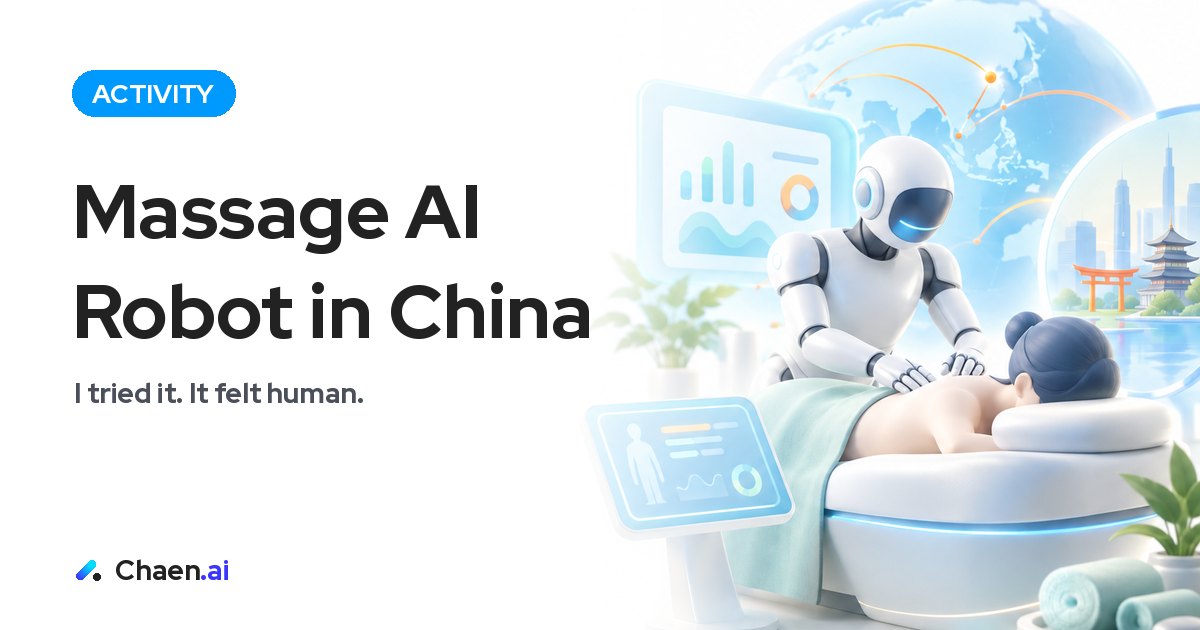
I tried a massage AI robot in China and at first thought a human was doing it. Here is what I verified, what I did not, and what it means for Japan.
I tried a massage AI robot in China. The short version: for the first moments I genuinely thought a person was doing it, and it was extremely comfortable. I came away thinking this could sell in Japan, and I posted that I intend to buy a lot of them. This piece covers what I actually observed, what I have not verified, and what I would need to check before bringing a product like this into the Japanese market. I will not fill in the maker, the price, or the internals, because I did not confirm them.
I tried a massage AI robot in China
I tested the actual machine on my own body. The feeling was simple: comfortable. But the thing that stayed with me afterwards was not the comfort itself. It was that at first I thought a human was doing it. The awareness of being touched by a machine never got a chance to form before the comfort arrived. As a way of judging an AI product, that matters a great deal.
I work with AI products every day, so I am used to new things and reasonably hard to impress. I still got it wrong. If someone who handles this category constantly reads it as human, a first-time user will read it the same way.
Why “I thought it was a person” is the real review
When I evaluate an AI product, I look less at the spec sheet and more at whether friction shows up. Friction is the single biggest reason people stop using something.
- If you need to read instructions to use it, people will not keep using it
- If the motion feels mechanical and makes you brace, the fear stays
- If all it has is first-time novelty, there is no second time and no word of mouth
This massage AI robot cleared that first gate. The comfort arrived before I had time to tense up. For a product that touches your body directly, that is genuinely impressive. With software, if something feels off you just close the window. With a machine that touches you, friction converts straight into fear. Clearing that was the surprise.
What I did not verify, and will not write
I also want to be explicit about what this article cannot tell you. I experienced the product. I did not confirm any of the following:
- The manufacturer or the product name
- The price or the terms of sale
- How it works internally or how the motion is controlled
- How it relates to safety standards or licensing rules inside Japan
- The maintenance and support setup
On price, my impression was that it is expensive, and I said as much in a reply on X — expensive, but I will buy it. I am not going to invent a number. The most dangerous thing in a hands-on report is letting enthusiasm carry you into claims you never checked. The experience was good; everything else is still unconfirmed, and I would rather draw that line clearly than sound more authoritative than I am.
Why I think a massage AI robot could sell in Japan
From here on, this is my own judgment rather than anything I verified. Three reasons.
First, users in Japan have their own standard for hands-on body care. Many people are used to treatment performed by human hands, so the comparison is unforgiving. If something passes that comparison well enough that a user mistakes it for a person, there is room for it to be accepted rather than treated as a novelty.
Second, consistency. With human hands, the result depends on who is working that day. If a machine can hold a steady level, the spread between a good session and a bad one narrows. Low variance is a quality that Japanese service operations tend to value highly, sometimes more than a higher peak.
Third, it needs no explanation. When I help Japanese companies adopt AI, the time sink is almost never the technology — it is building internal agreement. An experience-based product short-circuits that. You sit someone down and the explaining is over. Anything that does not require you to argue about performance in words spreads faster.
What I would check before bringing it to Japan
Since I said publicly that I want to spread this in Japan, I should write down my own homework. This is a machine that touches people, so the order of checks matters.
- Safety: how is it assured, how do you stop it, and what does it do when something goes wrong
- Regulation: how using it in Japan relates to domestic rules and licensing for body treatment
- Installation: floor area, power, and whether it can physically be brought into a building
- Maintenance: when it breaks, who fixes it and how long that takes
- Japanese language: whether the voice guidance and on-screen flow work as-is for Japanese users
- Consistency across bodies: whether people of different build and age get the same satisfaction
- Price and payback: how many sessions it takes for an operator to justify the unit
Until those answers exist, talking about volume is premature. A great experience and a deployable business are two different questions, and conflating them is how imported hardware ends up sitting in a corner unused.
What this says for overseas AI companies entering Japan
Having watched a lot of overseas products arrive in Japan, my main observation is that in this market the experience lands before the documentation does. I did not want to spread this because I read a deck. I wanted to because I sat in the chair.
- Make your first move in Japan a demo or a hands-on session; lead with the experience, not the numbers
- Prepare safety and maintenance answers as a set, because that is exactly where a Japanese counterpart stops the conversation
- Create actual owners and users early; in Japan, the existence of someone already using it is the strongest argument you have
- Make sure the people who tried it can describe it in their own words, without jargon
The inverse is also true. Companies that enter Japan by sending documents alone take a long time. If you have a physical product, bring it and let people touch it. That is faster than any amount of translated material.
How to apply this inside your own company
Two practical takeaways I brought home.
First, get primary information with your own body. If I had only watched clips of this, I would have stopped at “looks interesting.” Because I sat down with it in person, I got all the way to a decision about wanting it in Japan. Anyone responsible for AI adoption will reach decisions faster by trying one thing directly before collecting other people’s opinions.
Second, add “could you mistake it for a person” to your evaluation criteria. A model can score well and still fail inside a company if users brace themselves when they use it. For internal tools and customer-facing features alike, watch the first ten seconds and ask whether anyone tenses up. This massage AI robot hit that standard in hardware, which is a fair challenge to those of us working on the software side.
FAQ
Which company makes the massage AI robot you tried?
I did not name the maker or the product in my post, so I am not naming it here either. I tried the machine; I did not verify the company or its specifications.
How much does it cost?
I did not confirm a price. My impression was that it is expensive, and I replied on X that it is expensive but I will buy anyway. I have no figure to share.
Will it be available in Japan?
Nothing is settled yet. So far I have only said publicly that I intend to buy a lot of them. No distribution plan or timing exists at this point.
Based on a post on XOriginal post ↗
About the author

CEO of DigiRise Inc. Has supported 600+ companies and 50,000+ people with AI training, consulting and development. GMO AI & Crypto advisor, Google Gemini AI advisor. 200K+ followers on X.
Related articles
 Claude Meetings: Features, Pricing, and My Hands-On Test Nov 22, 2026
 Claude Code Conversational Control: What I Learned Nov 10, 2026
 Grok Bot MCP Integration: Running Claude Code from Chat Nov 10, 2026
 AI Replies: Why I Plan to Build a Reply System Nov 8, 2026
 Weekly AI Report: Robotics and Real-World Adoption Nov 8, 2026
 Claude Code Parallel Agents: 20 Sessions From a Conference Nov 7, 2026