ChatGPT Language Learning: Notes From a China Trip
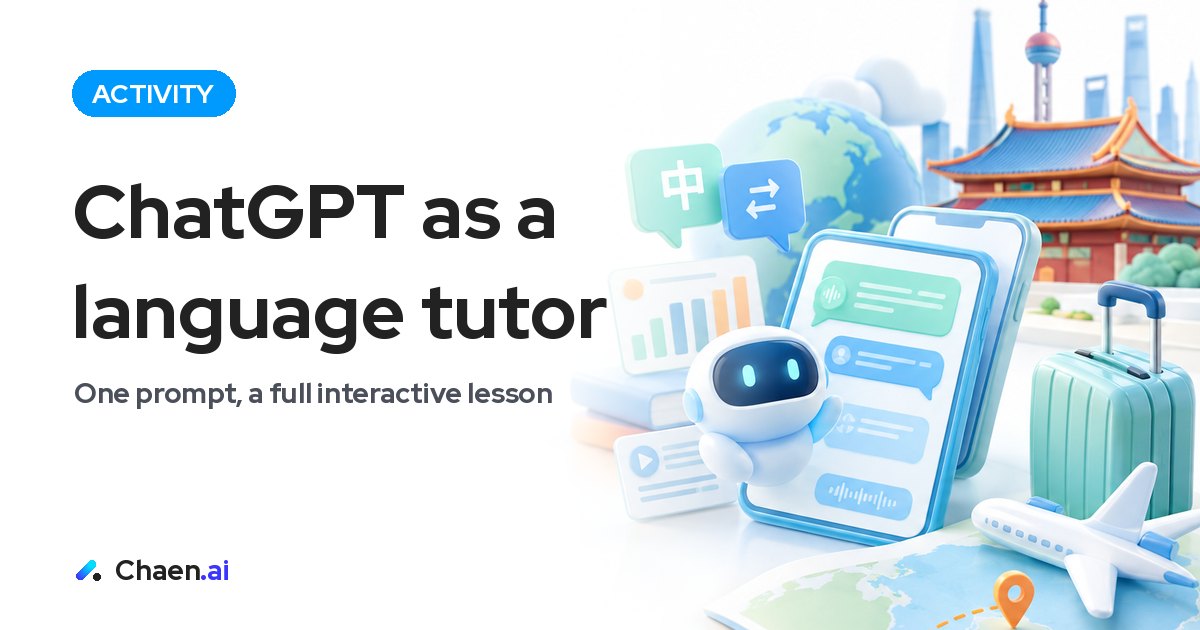
I used ChatGPT language learning on a business trip to China. Here are the nine things that appeared on screen, why a generated lesson beats a translation…
On a business trip to China I used ChatGPT to study Chinese, and what came back was not a translation — it was a lesson. This article breaks down the nine elements that appeared on screen, explains why a generated interactive material is different from a translation tool, and shares how I think about building the same thing with a single prompt. I am Masahiro Chaen, CEO of Digirise, and this is a record of what I observed, not a product review.
ChatGPT language learning that felt like a private tutor
When you are travelling in China for work, the number of moments where you actually need Chinese goes up fast. So I handed my Chinese study over to ChatGPT during the trip. What surprised me was not the accuracy of the answers. It was the construction of the screen. Instead of a wall of text, I got something assembled for learning. At that point it stops being a chatbot and starts being a dedicated language tutor.
Up to now these jobs lived in separate tools. Translation in a translation app, grammar in a textbook, pronunciation in an audio app, and comprehension checks somewhere else again. Learning one sentence meant moving across four products. Here all of it sat in one screen, and — more importantly — it could be reassembled on the spot to fit what I personally needed. That is the part I would call new.
A note for readers outside Japan: Japanese professionals learning Chinese usually work through Japanese-language material, which means the available textbooks are generic and travel-oriented. Being able to generate material in your own direction of translation, for your own vocabulary set, removes a real constraint.
The nine elements that appeared on screen
Broken down, here is what showed up:
- Japanese input translated into Chinese the way a native speaker would actually say it
- the Chinese, the pinyin, and the Japanese rendering displayed together as a set
- per-word notes on meaning, tone, and how to pronounce it
- tap a word and a fuller explanation expands
- filter vocabulary by category, for example AI terminology
- grammar and word order made visible with color coding and diagrams
- three paraphrases spanning casual to business register
- one-tap copy of the Chinese
- a multiple-choice quiz at the end to check comprehension
The structure hiding inside those nine
Lined up, the nine split cleanly into three layers. The entrance is translation. The middle layer is decomposition: pinyin and tone, per-word notes, grammar made visible, register variants. The exit is use and verification: copy the sentence, then prove you understood it.
That three-layer shape is not specific to language learning. Take a request at the entrance, decompose and expose the internals, then hand back something usable plus a check. It works for internal documentation, for research summaries, for onboarding material. This is why I read the episode as a case study in output design rather than a language-learning tip.
Why this is a generated material, not a translation tool
A translation tool returns an answer. One correct sentence appears and the interaction ends. What I got back was a material I could operate. Three differences stand out.
First, the reader controls the depth. Because explanations expand on tap, I could skim the words I already knew and dig only into the one that tripped me up. A fixed textbook forces the same depth on everyone; this does not.
Second, it bends to your field. The ability to filter by category — AI terminology, in my case — was the most telling feature on the list. Commercial courses center on travel and small talk, but the vocabulary I actually needed on the ground was about AI and business. If you can specify the bundle of words you need, your study priorities change completely.
Third, verification is included. The multiple-choice quiz at the end means the session does not finish with passive reading. Input and check sitting in the same screen lets the loop close in one sitting.
Put together, those three are the gap between looking something up and learning it. The first is a lookup. The second is a lesson built for one person at one moment.
Designing the single prompt: how I think about it
All of this came out of a single prompt. The thing worth emphasising is that it worked because I decided the output screen first, not because the instruction was long. Four habits carry most of the weight.
- Decide the finished screen before writing anything. Say out loud what sits next to what.
- Instruct in layers. Write the entrance, the decomposition, and the exit as separate blocks.
- Name your domain. Constraining the vocabulary range is what pulls the output toward real work.
- Bundle the check. Specify the form the comprehension test should take, not just the content.
The failure mode is the broad request. “Teach me Chinese” gets you a broad answer. The more precisely you describe the shape of the screen, the closer the output lands to usable material.
I had intended to post the prompt itself in the same thread, but it was too long to publish, so I will release it separately. If there is demand I will also build an English version — once the structure is fixed, swapping the target language should carry most of it across.
What this means for Japanese companies and for global AI products
For Japanese companies, language is an unavoidable operational cost. Coordinating with overseas offices, handling overseas customers, localising sales material — all of it runs through someone’s language ability. The traditional options were buying training material or hiring an instructor. Adding a third option, generating material in your own terminology on demand, changes the calculation. If your team can produce register variants that include your own product names and industry vocabulary, a meaningful slice of pre-training moves in-house. And the same pattern extends past language: onboarding explanations, procedure walkthroughs, comprehension checks for internal rules.
There is a lesson here for overseas AI companies communicating in Japan as well. What made me react was not a feature list. It was seeing how the screen changed. In Japanese organisations, both the person approving a tool and the person using it tend to evaluate it by how their own work changes, not by spec deltas against a competitor. One concrete use case showing the before-and-after of a screen travels further here than a list of capability names. That is my read from years of posting about AI products to a Japanese audience.
I would add one more observation. Showing the local language and Japanese side by side, rather than only one of them, lands particularly well with Japanese users. Being able to verify the gap between the two builds trust in the output. If you are designing a Japan-facing interface, that pairing is worth considering.
How to apply this in your own company
Pick one lookup task you repeat every week. It does not have to be language-related. Then write down the screen you want back: what appears side by side, where someone can go deeper, and what proves they understood. Draft those three layers before you draft the instruction, and the output starts arriving as material rather than as prose. Once the shape holds, you change the subject matter and reuse it. That, in the end, is all I did with Chinese.
FAQ
What does ChatGPT language learning actually produce?
In my case it produced more than a translation. The screen showed the Chinese sentence with pinyin and a Japanese rendering side by side, per-word notes on meaning and tone, color-coded grammar, three register variants, a one-tap copy button, and a multiple-choice quiz at the end. It felt like material you operate rather than an answer you read.
Is the prompt available?
Not yet. I tried to post it in the same thread but it was too long to publish, so I will release it separately. I would rather publish it properly than paste a trimmed version.
Will there be an English version of the setup?
Yes, if there is demand. The structure that worked for Chinese does not depend on the target language, so swapping the language should carry most of it over.
Based on a post on XOriginal post ↗
About the author

CEO of DigiRise Inc. Has supported 600+ companies and 50,000+ people with AI training, consulting and development. GMO AI & Crypto advisor, Google Gemini AI advisor. 200K+ followers on X.
Related articles
 Claude Meetings: Features, Pricing, and My Hands-On Test Nov 22, 2026
 Claude Code Conversational Control: What I Learned Nov 10, 2026
 Grok Bot MCP Integration: Running Claude Code from Chat Nov 10, 2026
 AI Replies: Why I Plan to Build a Reply System Nov 8, 2026
 Weekly AI Report: Robotics and Real-World Adoption Nov 8, 2026
 Claude Code Parallel Agents: 20 Sessions From a Conference Nov 7, 2026