Bank Cyberattack and AI Risk: What I'd Prepare Now
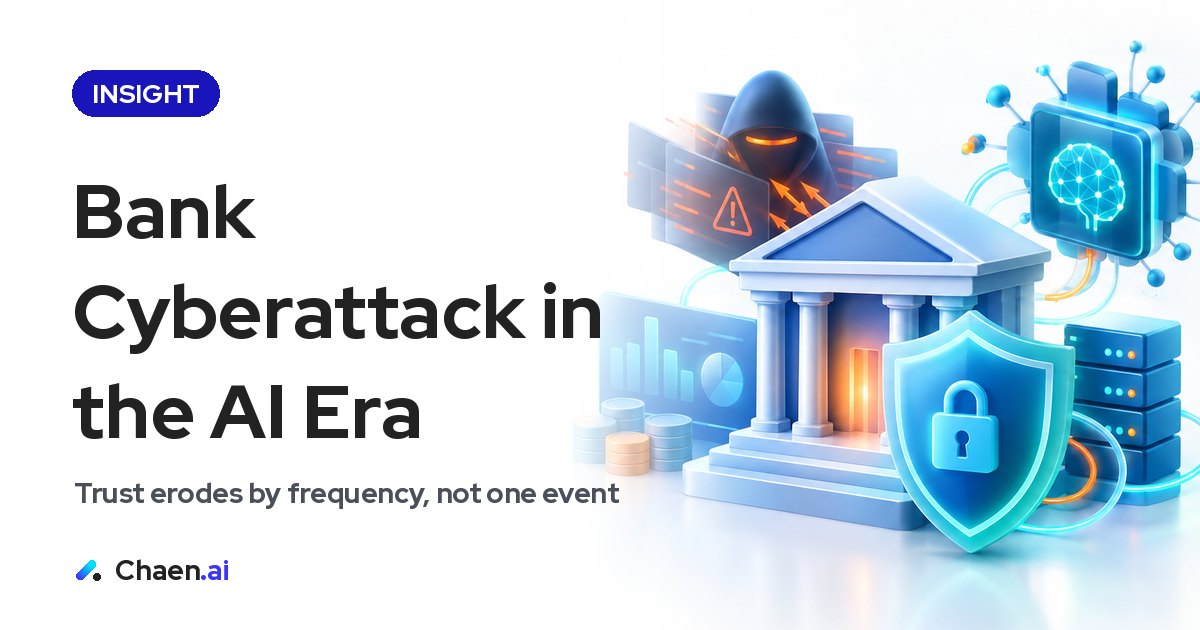
A major French bank was hit by a cyberattack with fraudulent transactions reported. Here is what is actually confirmed about this bank cyberattack, the AI…
A major French bank was hit by a cyberattack, fraudulent transactions followed, and some reports put the damage at around 21 billion yen. The bank itself says customer assets were not affected. My read: one incident does not destroy a bank’s credibility. But banking is a business built on trust, and what matters is frequency, not a single event. Below is what is actually reported, how this looks from Japan, and the two things I would prepare now.
What is actually reported about this bank cyberattack
The confirmed part is short, so here it is in full:
- A major French bank was hit by a cyberattack.
- Fraudulent transactions occurred as a result.
- Some reports put the damage at about 21 billion yen.
- The bank announced that customer assets were not affected.
That is the material. I do not know the intrusion path, the technique, or whether AI tooling played any role on the attacker’s side, and I am not going to fill those gaps with guesses. With financial incidents, speculation has no upside and real downside — it moves depositors before anyone knows anything. Everything from here is my reading, kept separate from the facts above.
I had posted this argument before, and the timing still surprised me
I had made the same argument in an earlier post. The response was roughly 90% agreement and 10% pushback. The pushback was mostly that I was fear-mongering, and on its face that is a fair criticism. Financial anxiety is self-fulfilling. If enough people act on a rumor, the rumor becomes true, and anyone who talks publicly about bank risk has to carry that weight rather than wave it away.
Still, to be honest: this news arrived faster than I expected. That is not a win. The useful conclusion is not “I was right” — it is that the timeline I had in my head was too long. When your assumed timeline shortens, the only sensible response is to move your preparations earlier, not to argue about who called it.
Banks run on trust, not on buildings or systems
What makes a bank strong is not its balance sheet alone; it is belief. As long as depositors believe the money is available whenever they want it, they do not all withdraw at once. The moment that belief wobbles, even a financially sound bank can find its funding position painful very quickly. This is a behavioral property, not an accounting one, which is why it is so hard to patch with capital ratios alone.
In this case the bank announced that customer assets were not affected, and I think that is why nothing structural breaks from one event. The variable to watch is repetition. If attacks like this become more frequent and depositor anxiety starts to chain from one institution to the next, the possibility of wider effects on the financial system cannot be dismissed. A single incident gets filed as an accident. A pattern changes how people behave — and trust tends to be worn down by the number of events more than by the size of any one of them.
AI cuts both ways: the attacker’s side gets faster too
When I say AI makes work faster, I have to accept the symmetric version of that sentence: it makes preparing an attack faster too. Research, drafting convincing text, reading and writing code — the tasks defenders are getting leverage on are the same tasks attackers need. I spend my working life helping companies adopt AI, which is exactly why I want to state this asymmetry plainly instead of leaving it as a footnote.
The asymmetry is in speed of adoption, not in access to tools. A defending organization has to get internal agreement, a budget line, a procurement process, and an operational owner before anything changes. An attacker has none of that overhead. Both sides can pick up the same capability; only one side has to hold a meeting about it.
None of this is an argument for slowing down AI. It is an argument that when the baseline assumptions change, your defensive updates have to move at the same speed as your productivity gains. Companies that sprint on one and crawl on the other are widening their own gap.
How this lands in Japan — and what companies here should actually check
In Japan, an incident at a European bank tends to be consumed as news about a faraway country. The institutions are unfamiliar, the currency is unfamiliar, and the story scrolls past. But there are concrete questions any company operating here can take from it:
- If a bank you rely on became temporarily unusable, would payments to suppliers and payroll still go out?
- Inside your own AI adoption, have authentication, permissions, or approval flows quietly started running without a human check?
- If an incident hit you, is it decided in advance what gets disclosed, within how many hours, and under whose name?
That third point is a communications question, and it is the part of this story I found most instructive. The bank put out a specific, checkable statement — that customer assets were not affected. The faster you publish the facts you can stand behind, the less room there is for speculation to fill. Japanese corporate communication often defaults to waiting until everything is understood, which is precisely the window in which rumor does its work. This applies far beyond finance.
If you are a global AI or security company selling into Japan
Japanese enterprise buyers check whether something is safe before they get excited about whether it is capable. If security posture and data handling live in the back half of your deck, you can lose the deal before you reach the table — not because the answer was bad, but because the reviewer never got to it. Reordering the same material changes the outcome. In the days after a story like this circulates, that ordering matters even more, because the person reading your deck has just been reminded of what their own risk committee will ask.
The preparation I actually do: spread it out
What an individual can do today is unglamorous. What I do is keep funds split across more than one bank. The reason is simple: if one account becomes temporarily unusable, my living expenses and payments do not stop. It is not a claim that a particular bank is unsafe. It is a refusal to depend on a single point.
A few questions worth answering honestly:
- Are your living expenses and your reserve sitting in the same single institution?
- Is your corporate account also consolidated into one bank?
- Do you retain any way to move money that does not depend on one online channel?
There is no need for excessive fear here, and I want to be careful not to push anyone toward panic. But preparation can only be built before the event. If you wait until something happens to diversify, you will be doing it at the same moment everyone else has the same idea — which is exactly when it works least well.
Taking this back to your own company
If you bring one thing home from this story, narrow it to two tasks. First, write down the fallback procedure for when a financial institution or an external service is temporarily unavailable — who does what, by hand if necessary. Second, list the places where speeding something up with AI also removed a human check, and decide deliberately whether that was the right trade. Neither requires new spending. When the underlying assumptions shift, the thing most worth revisiting is usually not the tooling but the procedure wrapped around it.
FAQ
Did customers lose money in the French bank cyberattack?
Based on what has been reported, fraudulent transactions occurred and some reports put the damage at around 21 billion yen. The bank itself announced that customer assets were not affected. Beyond that, nothing is confirmed at this point.
Does splitting money across several banks actually help?
It helps in one specific way: if one account becomes temporarily unusable, your payments and daily life do not stop. It is not a judgment that any particular bank is unsafe, just a way to avoid depending on a single point.
Will AI make cyberattacks more sophisticated?
I think that concern is real, because the work AI speeds up for defenders also speeds up preparation for attackers. But the specific method used in this case is not public, so I will not claim AI was involved here.
Based on a post on XOriginal post ↗
About the author

CEO of DigiRise Inc. Has supported 600+ companies and 50,000+ people with AI training, consulting and development. GMO AI & Crypto advisor, Google Gemini AI advisor. 200K+ followers on X.
Related articles
 AI Era Startup Advantage: Three Reasons It's the Best Time Nov 21, 2026
 Jensen Huang on His Successor: What Japan Can Learn Nov 15, 2026
 Why Elon Musk Keeps Working: 42 and Multiplanetary Life Nov 11, 2026
 AI Business Transformation Beyond Headcount Reduction Nov 9, 2026
 Open vs Closed AI Models: Jensen Huang's Dividing Line Nov 7, 2026
 Claude Code Support: The First Thing I Check in AI Tools Oct 29, 2026