Jensen Huang on His Successor: What Japan Can Learn
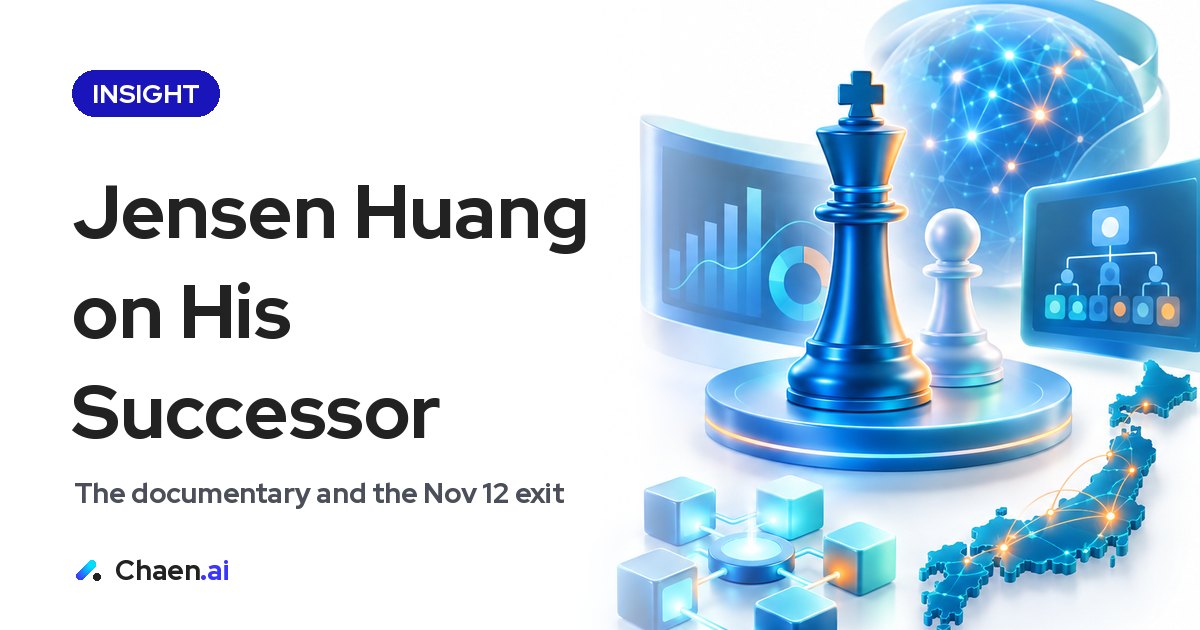
Jensen Huang discussed his successor in a Bloomberg documentary filmed a month before NVIDIA announced his immediate exit. What he said, what the company…
NVIDIA announced on November 12 that Jensen Huang was leaving his roles as CEO, president, and board member with immediate effect. In a Bloomberg documentary filmed the month before that announcement, he had already been discussing his own replacement: just as he himself could be fired, the next CEO has to be chosen too. This article sets what he said next to what the company actually announced, and turns it into questions you can ask about your own handover design.
The takeaway is not who comes next. It is whether the assumption that leadership must be continually earned is actually built into an organization. After 33 years at the top, what Huang was describing was not an appointment. It was a competition.
What Jensen Huang said about his successor
The scene comes from a new documentary by Bloomberg’s Emily Chang. Four points stood out.
- The next leader is already inside NVIDIA.
- Building the environment where successors grow is his own job.
- He likes a state where nobody can rest comfortably on an internal position.
- Having to keep winning your position is the healthy state.
Put together, these are one argument. The job of a chief executive is not to name a replacement and be done with it; it is to maintain a condition in which everyone, the chief executive included, is still being selected. The framing — that he himself could be fired — is what makes it credible. It says the founder is not exempt either.
The line about building the environment is worth pausing on. He does not hand succession off to an HR function or a leadership program. He keeps it inside his own job description. The word environment matters too: it reads as building a place where several people grow, not as grooming one chosen individual.
The filming happened the month before the resignation was announced. Hearing it now, the words land differently. But I would not read them as a hint that something was coming. The only thing we actually know is the sequence: the interview came first, the announcement a month later.
The gap between the documentary and the November 12 announcement
Here is what was announced.
- Huang leaves the CEO, president, and board roles immediately.
- CFO Colette Kress serves as interim CEO.
- The permanent successor will be considered from inside and outside the company.
- The November 17 earnings announcement goes ahead as planned.
Notice the distance between the two. Huang had said the next leader was already inside. The company says it will look inside and outside. Which way it resolves has not been announced, so I am not going to claim I know.
There are several reasonable readings. A founder’s private conviction about who is ready and a board’s formal search process are simply different objects; believing the answer is internal and running an open process are not contradictory. It is also possible the situation shifted. From the outside there is nothing definitive to say. The sensible posture is to watch whether the appointment ends up being internal.
One detail I would not skip: the company explicitly said earnings would proceed on schedule. That sentence is a statement about operational design. Even with the top job vacated on the spot, the dated, recurring obligations keep running. Whether a company can say that in its own announcement is a fairly honest measure of how prepared it was.
Turning “keep earning your position” into structure
As a sentiment, this does not survive contact with a real org chart. To make it structural, I think about three things.
Make replaceability something you actually reward
Is the person who built a function that runs without them the person who gets promoted? In most organizations it is the opposite: the indispensable bottleneck gets treated as valuable. Under that incentive, hoarding context beats developing successors, and no amount of talk about earning your position changes it.
Decide the interim slot while things are calm
For each critical role, decide now who holds it on an interim basis if the incumbent disappears. NVIDIA had a CFO stepping in as interim CEO the same day. The point is not that finance chiefs make good interim leaders; the point is that the order of succession existed before it was needed. It also helps to treat interim as a distinct role, not a probationary audition for the permanent job.
Decide in advance what never stops
Dated obligations — earnings, regulatory filings, customer delivery milestones — keep moving regardless of who left. Equally, decide what is allowed to pause. Without that line drawn, every leadership change stops everything by default.
How this reads from Japan, and what it means for AI programs here
I work on AI adoption inside Japanese companies, and the same shape shows up constantly at a smaller scale. The AI effort depends on one internal champion. That person transfers to another department and the program quietly stalls. A capability carried this far by one person’s individual skill looks strong and is actually fragile.
A checklist I use:
- Is it written down who owns AI-related decisions?
- If that person left tomorrow, is it decided who holds it the next day?
- Are prompts and operating rules shared assets rather than personal notes?
- Is the relationship with external vendors held by more than one person?
- Are there multiple internal candidates, each visibly leading a different initiative?
Huang’s line about building the environment where successors grow translates directly here. The goal is not to produce one person who is good with AI tools. It is to build a setting where the number of such people increases. Whether that is part of how managers are evaluated is what separates two otherwise identical programs a year later.
If you are a global AI company communicating a leadership change in Japan
A note for companies announcing into the Japanese market. In my experience, what Japanese customers and media want first in a leadership transition is not a profile of the new person. It is continuity. Do contracts change? Do delivery dates change? Who is the point of contact now? What happens to the local entity? An announcement that skips these reads as uncertainty, and uncertainty stalls deals.
NVIDIA mentioning that earnings would proceed on schedule is the same category of information. Stating plainly that a known date does not move is itself reassurance. The word interim needs care in Japanese-language announcements too. Being vague about an interim arrangement invites distrust later; but if interim is read as nothing can be decided for now, procurement conversations freeze. Spelling out what the interim leader is actually empowered to decide is the considerate version.
How to use this inside your own company
One concrete action: write down, on a single page, who holds what if you personally disappear tomorrow. The parts you cannot fill in are the real weak points. Then fix the incentive so that making yourself replaceable is rewarded rather than penalized. A state where leadership is continually earned is not produced by willpower; it is produced by design. A 33-year leadership change is only useful news if you translate it down to the handover of the work in front of you.
FAQ
When did Jensen Huang step down from NVIDIA?
NVIDIA announced on November 12 that Huang was leaving his roles as CEO, president, and board member with immediate effect. CFO Colette Kress was named interim CEO.
Will the next NVIDIA CEO come from inside the company?
The company says it will consider candidates from both inside and outside. In the documentary Huang said the next leader was already inside NVIDIA. Which path it takes has not been announced.
Was NVIDIA's earnings date affected?
The November 17 earnings announcement is going ahead as planned. The regular reporting cycle was kept intact despite the immediate leadership change.
Based on a post on XOriginal post ↗
About the author
CEO of DigiRise Inc. Has supported 600+ companies and 50,000+ people with AI training, consulting and development. GMO AI & Crypto advisor, Google Gemini AI advisor. 200K+ followers on X.
Related articles
 AI Era Startup Advantage: Three Reasons It's the Best Time Nov 21, 2026
 Why Elon Musk Keeps Working: 42 and Multiplanetary Life Nov 11, 2026
 AI Business Transformation Beyond Headcount Reduction Nov 9, 2026
 Open vs Closed AI Models: Jensen Huang's Dividing Line Nov 7, 2026
 Bank Cyberattack and AI Risk: What I'd Prepare Now Nov 6, 2026
 Claude Code Support: The First Thing I Check in AI Tools Oct 29, 2026