AI Business Transformation Beyond Headcount Reduction
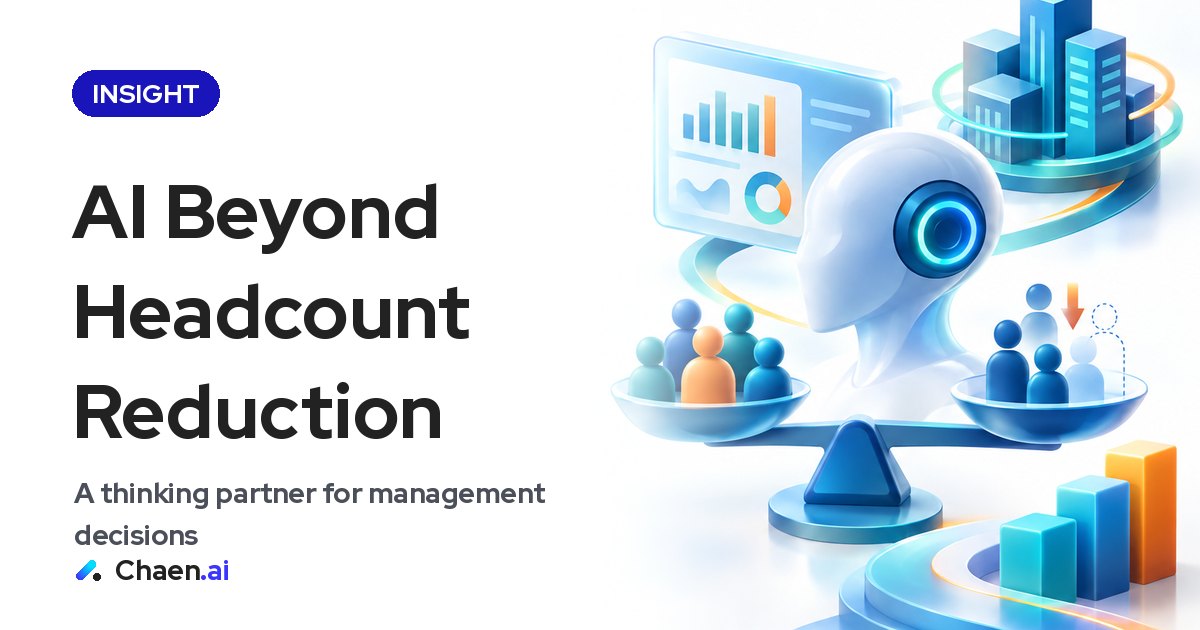
AI business transformation should go beyond job cuts. I examine Kai-Fu Lee's argument and its implications for management and Japan.
AI business transformation should include help with management thinking, not just a calculation of how many jobs can be removed. I explain why I agreed with Kai-Fu Lee’s argument, how I would turn it into a practical discussion process, and what I would emphasize when communicating it in Japan.
AI business transformation: the argument I agreed with
My post discussed remarks by Kai-Fu Lee during an appearance on CNBC’s Squawk Box as the author of AI Native. The video I shared was a roughly 40-second version with Japanese subtitles.
The argument focused on executives looking for AI applications in customer service, legal, and finance while seeking headcount-reduction figures. I agreed with the underlying challenge: defining AI’s purpose only through reductions gives it too narrow a role.
The example involving 1,000 agents and 200 fewer employees should be read as an illustration of that mindset, not as a reported implementation result. Likewise, I would not turn the claim about “99%” of CEOs into a statistical description of businesses generally.
The “IQ 300” language also needs a clear boundary. It was Lee’s analogy, not a measured score. What interested me was the management question behind it: if you expected substantial capability from someone, would you ask only for routine work, or also for help thinking about the business?
The post supplied this source link and this additional source link. The process below is my proposed application of the argument, not an additional account of what Lee said.
Task replacement and management thinking are different uses
I am not arguing against AI applications in customer service, legal, or finance. My concern is making “How much existing work can we remove?” the only question that defines an initiative.
Task replacement starts with the work as it currently exists. Management discussion can also question whether that arrangement serves the intended objective. These are different levels of inquiry, and I would keep both visible.
For a customer-service discussion, for example, I would first clarify what the business wants to change. Is the objective to reduce the workload? What does it want from its customer relationships? Does the current organization of the work support that objective? These are proposed discussion questions, not claims about a particular company’s experience.
Using AI this way does not mean assuming it will produce the right strategy. I would use it to examine alternatives and assumptions that deserve attention. Receiving an answer and completing a decision are separate events.
Nor is this an either-or choice. A team can examine the execution of a task while management examines its purpose. The important point is to know which question is being asked and what kind of assistance would count as useful.
How I would frame an AI management discussion
I would begin with a decision the business is actually considering, rather than an open-ended request to find something to do with AI. Without a clear objective, I have no useful basis for deciding whether its response helps.
Before asking for advice, I would separate the inputs:
- Objective: what should this decision accomplish?
- Known facts: what has actually been established?
- Constraints: what conditions must the decision respect?
- Unknowns: what information is still missing?
- Alternatives: which options are already under consideration?
I would be particularly careful not to present a desired outcome as a current fact. An expectation about what might happen belongs in a different category from something the business has confirmed. Missing information should remain visibly missing rather than being filled in for convenience.
Next, I would ask for material that supports deliberation, not simply a preferred conclusion. Useful prompts for that purpose include asking what assumptions an option depends on, what other options serve the same objective, and what change in conditions would justify revisiting a decision.
After reading the response, I would check it against the inputs. If it introduces unconfirmed information about the company, I would remove that from the basis for discussion. If it misunderstands a constraint, I would correct it. I would then identify what still requires human confirmation before a decision can be made.
This is a way I would structure the conversation. It is not a claim that the video demonstrated this workflow or that following it guarantees a better outcome.
Evaluate decision preparation, not only jobs removed
If the purpose is management assistance, I would evaluate the work against that purpose. A polished answer is not enough. I want to know whether the basis for a decision has become clearer.
My review would ask:
- Did I distinguish the objective from the proposed means of achieving it?
- Did the discussion identify alternatives worth considering?
- Are the assumptions behind each option more explicit?
- Are confirmed facts separated from unresolved questions?
- Can I explain why an option should be rejected as well as accepted?
These are proposed review criteria, not promised results. If the discussion changes none of those things, I would revisit the question or the information supplied rather than count the mere use of AI as progress.
I would also avoid treating agreement as evidence of value. An answer that supports my initial preference does not establish that its assumptions are sound. Asking for the opposing case can be part of the review, but that response also needs examination.
The final question remains: what grounds does the business have for its decision? “AI recommended it” is not the explanation I would accept. Using a discussion partner and transferring responsibility are not the same thing.
What I would emphasize for Japanese businesses
For a Japanese company considering this argument, I would start by clarifying what it expects AI to do, rather than making the discussion only a debate about job cuts. Naming a department does not tell me whether the intended role is task execution or help with a management decision.
In an internal explanation, I would show the operational task and the management question separately. I would then identify which information needs confirmation and who makes the final choice. This is my suggested approach, not a claim that Japanese companies all follow a particular adoption pattern.
For overseas AI and technology companies addressing Japan, I would apply the same distinction to messaging. The Japanese-subtitled clip in this thread carries a strong argument in a short format. When presenting it, I would keep the qualification attached to the memorable phrase: “IQ 300” is an analogy, not a measurement.
Similarly, I would not present the agent and employee figures as a customer outcome. A rhetorical example should not become a product promise through repetition.
In a product discussion, I would want to hear more than how much work could be replaced. Which decision is the user examining? What information goes into the discussion? What must be checked afterward? Where does a person decide? Explaining that sequence would give me a clearer basis for considering its relevance to a Japanese business, without relying on a broad claim about the market.
Applying this view inside a business
I would start with an unresolved management question, separate facts from assumptions, and use AI to examine the options. I would review the exercise by asking whether the decision is better prepared, not only whether work could be removed.
That is the perspective I took from the remarks: use AI not just to reduce activity, but also to think more carefully about what the business should do.
FAQ
Why should AI business transformation go beyond headcount reduction?
My concern is that a headcount-only goal restricts AI to replacing existing work. In my post, I argued for also using AI as a discussion partner for management, rather than defining its value only through jobs removed.
Is Kai-Fu Lee's description of AI as having an IQ of 300 a measured result?
No. The thread explicitly identifies it as his analogy, not a measured score. It should not be presented as evidence that AI can make correct management decisions.
What does it mean to use AI as a management thinking partner?
I mean using AI to examine management questions rather than only assigning it replacement tasks. That is different from handing over the final decision: my emphasis is on assistance with thinking, not an assurance that its conclusions are correct.
Based on a post on XOriginal post ↗
About the author

CEO of DigiRise Inc. Has supported 600+ companies and 50,000+ people with AI training, consulting and development. GMO AI & Crypto advisor, Google Gemini AI advisor. 200K+ followers on X.
Related articles
 AI Era Startup Advantage: Three Reasons It's the Best Time Nov 21, 2026
 Jensen Huang on His Successor: What Japan Can Learn Nov 15, 2026
 Why Elon Musk Keeps Working: 42 and Multiplanetary Life Nov 11, 2026
 Open vs Closed AI Models: Jensen Huang's Dividing Line Nov 7, 2026
 Bank Cyberattack and AI Risk: What I'd Prepare Now Nov 6, 2026
 Claude Code Support: The First Thing I Check in AI Tools Oct 29, 2026