Why Elon Musk Keeps Working: 42 and Multiplanetary Life
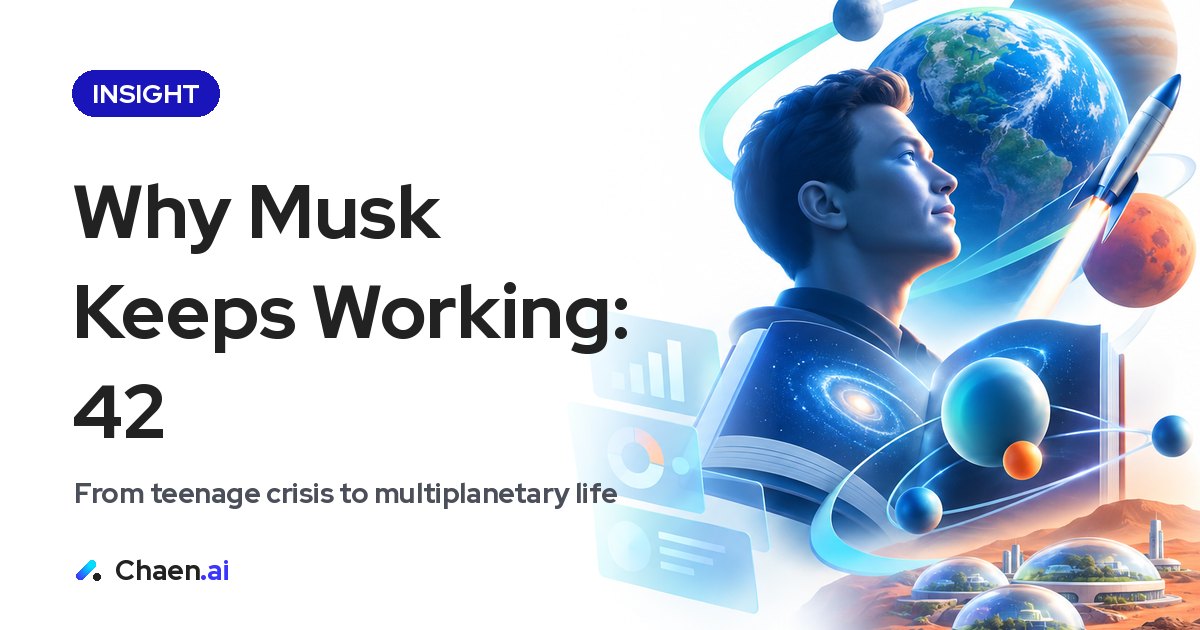
Why Elon Musk keeps working, in his own three-minute account: a teenage existential crisis, the number 42, and the case for multiplanetary life.
I watched a video of Elon Musk explaining, in about three minutes, why he keeps working. My takeaway first: if you want to understand where SpaceX and xAI are pointed, this is the clearest explanation I have seen. Below I lay out the line of reasoning in the video, then what AI teams in Japan and overseas AI companies targeting Japan can actually do with it.
One caveat up front. The original post does not state when the video was recorded or who the interviewer was. The watermark on the video reads @jaynitx. So what follows is the content of the video plus my own reading of it, and nothing else.
Why Elon Musk keeps working, explained in about three minutes
Compressed to one line, the video says: the universe is already the answer, and what is missing is the right question.
The path he takes to get there:
- As a teenager he struggled because he could not see the meaning of life
- Neither religious texts nor German philosophy gave him an answer
- The turning point was the number 42 in The Hitchhiker’s Guide to the Galaxy
- The universe is the answer; the missing piece is the right question
What struck me most is the length. Decks that explain a company’s direction tend to run dozens of slides, yet three minutes is enough here. The reason, I think, is that he starts from the origin of the motivation rather than from a list of businesses. When the order runs “why, therefore what,” the explanation gets short. Explanations that balloon usually start from “here is what we are doing” and then bolt meaning on afterwards.
The same gap shows up in internal communication. When you present an AI rollout, you can open with a list of tools and features, or with one sentence about why any of it is needed. The first takes more slides and leaves less conviction. The second is short and people can actually repeat it to someone else.
The teenage existential crisis at the root
The starting point is not a business thesis. It is personal difficulty. As a teenager he could not see the meaning of life, and reading religious texts and German philosophy did not resolve it.
Why is that easy to listen to? Because he is not speaking as someone who holds the answer. When a story opens with “I was stuck and it hurt,” the listener has nothing to argue against yet. Only then does it move to “so here is how I decided to think about it.” Even people who reject the conclusion can follow the reasoning.
This is a usable shape for any founder explaining a vision. Open with market size and competitive dynamics and anyone who disagrees with slide one checks out. Open with what problem drove you into this work and you at least get heard to the end. In Japanese meetings this matters more than people expect: a pitch that opens with numbers tends to turn into a game of finding counter-numbers. Opening with motivation changes the nature of the discussion itself.
The 42 problem: an answer is worthless without the right question
The turning point came from Douglas Adams. In the novel, Earth is a giant computer built to calculate the meaning of life, and the answer it produces is 42. The computation finishes, but nobody knows what the question actually was. So 42 is useless.
From there Musk moves to the view that the universe itself is the answer, and what is missing is the right question. Receiving an answer while the question stays vague gets you nowhere.
Anyone using generative AI daily already lives this. Give a model a sloppy instruction and you get back competent prose that you cannot use. The model was not underpowered. You had not decided what you wanted to know. Structurally it is the same as 42.
I think this overlap is the most practically important part of the video. As answer-generation gets cheaper, the bottleneck shifts from the side producing answers to the side framing questions. So when an AI initiative stalls inside a company, the first thing to audit is not the model or the tooling. It is whether anyone can write, in one sentence, what problem you were trying to solve. If nobody can, you will get more output and the same decisions.
Expanding consciousness, biological and digital
The conclusion follows from the setup. The more you expand the scale of consciousness, the closer you get to asking the universe the right question. So increase human consciousness, increase both biological and digital consciousness, and become a multiplanetary and eventually interstellar species.
Seen along that single line, the space work and the AI work stop looking like two unrelated businesses. Both expand the number of entities capable of framing a question; one expands into physical space, the other into computation. That consistency is why I said this is the clearest available explanation of where SpaceX and xAI are pointed.
Whether that worldview is correct is a separate matter, and plenty of people will not share it. But you can at least check, in his own words, whether the activities contradict each other. When you are trying to understand a company, grabbing a three-minute account like this is often faster than tracking individual announcements.
How this lands in Japan and what it means for AI teams here
Japan is a useful test case for this kind of story, because the default corporate mode here is incremental and evidence-first rather than mission-first.
For Japanese companies rolling out AI
In most Japanese organizations an AI discussion opens with reference cases and a cost-benefit check. Those steps are necessary, but if the purpose is never stated in one sentence, nobody can say afterwards what was achieved.
Changing the order alone changes a lot:
- Write, in one sentence, what problem this initiative is meant to solve
- If you cannot write it, stop tool selection and go back to defining the question
- Evaluate on which decisions changed, not on how much output was produced
The 42 story travels well internally as a warning: more answers do not help while the question stays vague. In a meeting, a concrete example borrowed from a novel lands better than an abstract principle.
For overseas AI companies entering Japan
When overseas AI companies explain themselves in Japan, the material usually centers on feature lists and benchmark numbers. But the Japanese counterpart in the room has to secure internal approval afterwards. My read is that they need one portable sentence about why your company does this work, before they need the feature list.
A motivation you can deliver in three minutes survives translation. Feature tables have to be rebuilt every release cycle; the reason you exist does not change. In Japan especially, the person who brought your proposal inside will have to explain it to their own manager. Whether you handed them short language they can reuse often decides whether the evaluation moves forward at all.
Putting this to work in your own organization
Two things you can do immediately. First, write one sentence stating what problem your AI efforts are meant to solve. If you cannot, you are not yet at the stage of adding tools. Second, cut your own company explanation down to three minutes. If what survives the cut is motivation, it will carry. If all that survives is a list of features, there is room to reorder.
The ability to produce answers gets cheaper every year. It is worth rebuilding how your organization works on the assumption that framing the question is the part that stays.
FAQ
Why does Elon Musk say he keeps working?
He traces it back to a teenage period when he could not see the meaning of life. He concluded that the universe itself is the answer and the missing piece is the right question, so he works to expand the scale of consciousness.
What is the significance of 42 in the video?
In Douglas Adams' The Hitchhiker's Guide to the Galaxy, Earth is a giant computer calculating the meaning of life, and the answer it returns is 42. The point that an answer is useless without the right question became Musk's turning point.
When was the video recorded and who was interviewing?
The original post does not state the recording date or the interviewer. The watermark on the video reads @jaynitx.
Based on a post on XOriginal post ↗
About the author

CEO of DigiRise Inc. Has supported 600+ companies and 50,000+ people with AI training, consulting and development. GMO AI & Crypto advisor, Google Gemini AI advisor. 200K+ followers on X.
Related articles
 AI Era Startup Advantage: Three Reasons It's the Best Time Nov 21, 2026
 Jensen Huang on His Successor: What Japan Can Learn Nov 15, 2026
 AI Business Transformation Beyond Headcount Reduction Nov 9, 2026
 Open vs Closed AI Models: Jensen Huang's Dividing Line Nov 7, 2026
 Bank Cyberattack and AI Risk: What I'd Prepare Now Nov 6, 2026
 Claude Code Support: The First Thing I Check in AI Tools Oct 29, 2026