Open vs Closed AI Models: Jensen Huang's Dividing Line
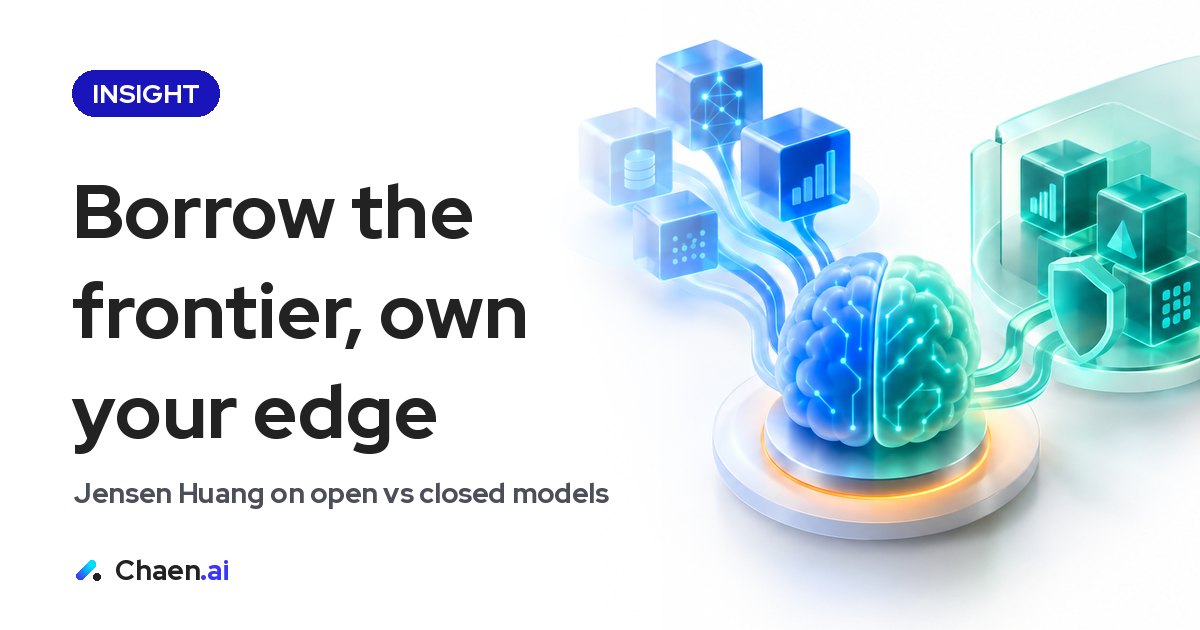
Jensen Huang on open vs closed AI models: use the frontier closed models now, build your own intelligence on open models later, and release what you can.
Should you use a closed model or an open one? Jensen Huang’s answer is both — and the interesting part is the order he puts them in. Talking with Box CEO Aaron Levie, he argued that everyone should be using the most advanced closed models, while every company will eventually build its own intelligence on open models. I was there and filmed it, then added English and Japanese subtitles. This piece lays out his four points and how I would think about where to draw the line between what you borrow and what you own.
Jensen Huang’s four points on open vs closed models
His whole argument fit into four short sentences:
- Everyone should use the most advanced closed models
- Every company will eventually build its own intelligence on open models
- Release everything you can release — that is the first principle of business
- What is left at the end is intelligence specialised to your own domain
Lined up like that, they can read as contradictory. Use the frontier, but build your own. Build your own, but give away what you have. Separate them by time horizon and by scope, though, and they form a single line. The work in front of you today runs on the best closed model available. In parallel you grow an intelligence that is specific to your own domain. And you release whatever you can release, so that improvements come back to you from the outside. These are three things that run at the same time, not three stages you wait through.
Borrowing the frontier comes first
What struck me most was the ordering. He did not open with building your own. He opened with everyone should be using the most advanced closed models. In-house discussions tend to run the other way: evaluate building first, adopt later. But if nobody in the company has actually worked with the smartest thing currently available, you are not in a position to decide what is worth building. Borrowing and owning are not opposed. What you learn by borrowing becomes the blueprint for what you own.
“Release everything you can” as a first principle
“Release everything you can release — that is the first principle of business” came from someone arguing for the open side, and that is how I took it. Holding on to something you could have released does not buy you a durable advantage. The more something gets used, the more improvement and knowledge flows back. The same logic applies to how a company communicates. Keeping your know-how to yourself when you could publish it gets less and less defensible every year. The real work shifts from deciding what to publish to deciding what genuinely cannot leave the building.
What is left is intelligence specialised to your domain
The fourth point is the conclusion. Anything everyone can use is not a differentiator. What remains is intelligence that is closed around your own domain. That is not a statement about model size or novelty — it is a statement about what you taught it. As long as you run the same model the same way as everybody else, there is no gap to speak of.
His closing line: the technology is already all there
He finished roughly like this. If you want to put closed models to work inside your company, you connect them with Context Engine. If you want to build your own AI out of your internal knowledge, you can do that too. The technology is already all there.
In other words, “the tooling is not ready yet” is no longer a reason to wait. There is a path for the borrowing side and a path for the owning side. Which leaves one open question, and it is not a technical one: what do you connect, and what do you teach it? A company that has not answered that will stall in exactly the same place no matter which model arrives next.
My own bet: open models reach today’s frontier class within two years
Here is my own prediction. Within two years I expect open models to reach the level of today’s frontier class and to get smaller at the same time. Once that happens, having your own model stops being an exotic investment. If today’s frontier becomes the standard baseline, then the only things left to differentiate on are your own data and the context of your own operations.
It is a prediction, so it may be wrong. But it is worth thinking about how it could be wrong. If open models do not catch up, you simply keep borrowing, and nothing is lost. If they do catch up and your internal knowledge is still scattered, you cannot move to the owning side even though the option exists. Either way, getting your internal knowledge into a usable form is not wasted work. The bet is asymmetric: you only need to prepare for one of the two outcomes.
Borrow or own is a management decision, not a technical one
Framing this as “use an outside model or build our own” is what kills the conversation. The real question is where the line sits between what you borrow and what you own. That line looks like a technical call and is actually a management call. The order I would work through it:
- Which work is fine to send outside? Hand that to the best closed model available.
- Which knowledge do you not want leaving the company? That is the candidate for the owning side.
- Where does that knowledge physically live today? If it only exists in people’s heads, you cannot teach it to anything yet.
- Where can you honestly claim to know your domain better than anyone else? That is the substance of your specialised intelligence.
- What could you release without harm? If publishing it brings back reputation and improvements, stop hoarding it.
Work through it in that order and neither “build everything” nor “buy everything” survives. What you end up with is a table of lines drawn task by task. And because it is a table, you can redraw it when the technology moves.
How this lands in Japan — and what it means for foreign AI companies
When this topic comes up in Japan, attention tends to collect around which frontier model is strongest right now. Model rankings move. What lasts is the unglamorous work of getting your own knowledge into a usable form. If internal documents and tacit know-how stay scattered, the result does not change much whichever model you pick. The companies that pull ahead will be the ones willing to staff knowledge cleanup with the same energy they put into model selection.
There is also something here for overseas AI companies communicating in Japan. “You should use the frontier” and “you can build your own” easily sound mutually exclusive to a Japanese buyer, and when it stops being clear which claim is on the table, the evaluation stalls. Splitting the two by time horizon the way Huang did makes it land. And he is genuinely good at this. He breaks the argument into four short sentences, delivers them in order, and closes on “the technology is already all there.” Foreign companies presenting in Japan can copy that structure directly. In any room with interpretation or subtitles, short sentences are the ones that survive — I noticed that clearly while subtitling this myself.
How to use this in your own company
Start by getting everything you can out of the best closed model available, in real work, not in a pilot. In parallel, inventory the knowledge that cannot leave the company and put it into a form something can actually read. Then draw your borrow-versus-own line and redraw it on a regular cadence. The better open models get, the further that line moves toward owning. The job right now is to be in a position to move when it does.
FAQ
Does Jensen Huang recommend closed models or open models?
Both. He said everyone should be using the most advanced closed models, and that every company will eventually build its own intelligence on open models. What remains in the end, in his framing, is intelligence specialised to your own domain.
How should a company prepare to own its own model?
Start with the knowledge you would never send outside the company and get it into a usable form. Huang closed by saying the technology is already all there, so the open question is not tooling but what you connect and what you teach it.
How fast do you expect open models to catch up?
My own bet is that within two years open models reach today's frontier class and get smaller at the same time. It is a prediction and it may be wrong, but organising your internal knowledge pays off either way.
Based on a post on XOriginal post ↗
About the author

CEO of DigiRise Inc. Has supported 600+ companies and 50,000+ people with AI training, consulting and development. GMO AI & Crypto advisor, Google Gemini AI advisor. 200K+ followers on X.
Related articles
 AI Era Startup Advantage: Three Reasons It's the Best Time Nov 21, 2026
 Jensen Huang on His Successor: What Japan Can Learn Nov 15, 2026
 Why Elon Musk Keeps Working: 42 and Multiplanetary Life Nov 11, 2026
 AI Business Transformation Beyond Headcount Reduction Nov 9, 2026
 Bank Cyberattack and AI Risk: What I'd Prepare Now Nov 6, 2026
 Claude Code Support: The First Thing I Check in AI Tools Oct 29, 2026